A complete fire protection system consists of both active and passive components working together to detect fire, suppress it, contain its spread, and guide occupants to safety. Active components include fire sprinkler systems, fire alarm systems, kitchen fire suppression systems, fire pumps, and emergency lighting. Passive components are built into the building’s structure: fire-rated walls, smoke barriers, fire doors, and floor-ceiling assemblies. For property managers, building owners, HOA boards, and general contractors, understanding how these components work is essential for compliance. Aura Fire Safety provides fire protection services covering all active fire protection systems for commercial and multi-unit residential properties throughout the San Francisco Bay Area.
Get in Touch for Fire Protection Services
What Is the Difference Between Active and Passive Fire Protection?
Active fire protection requires a triggered response to detect or suppress fire. Passive fire protection uses structural building elements to contain fire and slow its spread without any activation. Both categories are required under the California Building Code and enforced by the local Authority Having Jurisdiction (AHJ).
Active systems either activate automatically when fire conditions are detected or can be triggered manually. Fire sprinkler systems, fire alarm systems, kitchen suppression systems, and emergency lighting all fall into this category.
Passive systems are built into the structure itself and require no activation to function. Fire-rated walls, smoke barriers, fire doors, floor-ceiling assemblies, and firestopping around pipe and cable penetrations all work by physically blocking the movement of fire and smoke through the building. Compartmentation divides a building into sections so that a fire in one area cannot freely spread to adjacent spaces.
The two categories are designed to complement each other. Passive elements buy time by slowing fire spread. Active systems suppress fire and alert occupants while evacuation is still possible.
ALSO READ: How Long Does a Fire Alarm Inspection Take? What Property Managers Should Plan For
What Is a Fire Sprinkler System and How Does It Work?
Fire sprinkler systems are water-based active suppression systems that activate when a sprinkler head’s heat-sensitive element reaches its rated temperature threshold, typically 155°F to 165°F for standard heads. Only the head or heads directly above the fire activate. Every other head in the building remains inactive.
There are four main types of fire sprinkler systems:
- Wet Pipe: The most common type. Water is constantly pressurized in the piping and discharges immediately when a head activates.
- Dry Pipe: Pipes contain pressurized air instead of water. Used in unheated spaces where pipes could freeze, such as parking garages and loading docks.
- Pre-Action: Requires two separate triggers before water releases. Used in areas with sensitive equipment where accidental discharge would cause significant damage.
- Deluge: All heads discharge simultaneously when the detection system activates. Used in high-hazard areas requiring rapid, large-volume water application.
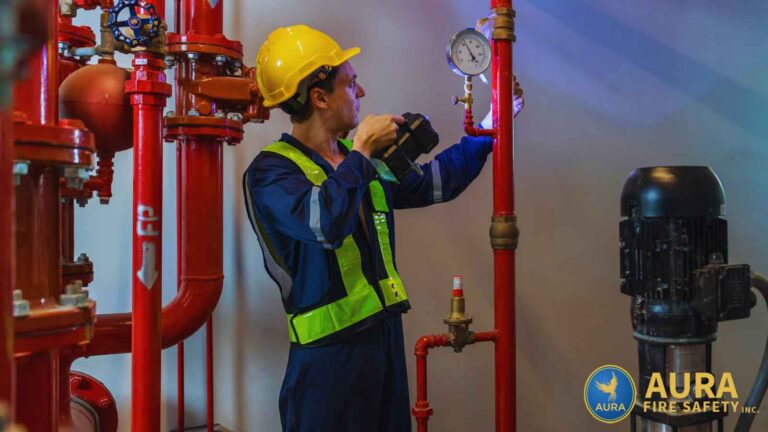
Key components include sprinkler heads, control valves, the riser, alarm valve, fire department connection, flow switches, tamper switches, and pressure gauges. California Title 19 and NFPA 25 require quarterly visual inspections, annual functional testing, and a 5-year certification that includes an internal pipe inspection. Aura Fire Safety handles all three intervals. Learn more about our fire sprinkler inspections.
What Does a Fire Alarm System Include?
Fire alarm systems detect fire conditions through smoke and heat detectors and alert building occupants through horns, strobes, and in many cases, a 24-hour monitoring station that dispatches the fire department. Detection happens automatically. Notification is both local (devices in the building) and remote (monitoring station).
The core components of a fire alarm system include:
- Fire Alarm Control Panel (FACP): The central hub that receives signals from detection devices and triggers notification devices throughout the building.
- Smoke and Heat Detectors: Detect fire conditions automatically. Duct smoke detectors monitor HVAC systems to prevent smoke from circulating through the building.
- Manual Pull Stations: Allow occupants to trigger the alarm manually when fire is observed.
- Notification Devices: Horns and strobes alert occupants throughout the building. Speaker systems are used in buildings requiring voice evacuation.
- Flow and Tamper Switches: Connect the fire sprinkler system to the alarm panel so a sprinkler activation automatically triggers the alarm.
Addressable panels identify the exact device that triggered the alarm, allowing the fire department and building staff to pinpoint the location immediately. Conventional panels identify only the zone, not the specific device. For larger or more complex buildings, addressable systems are the standard.
NFPA 72 governs inspection requirements. Annual testing covers every detection device, notification device, battery load, and panel function. For certain occupancy types, 24-hour monitoring is required, connecting the system to a central station that notifies the fire department when an alarm activates. Aura Fire Safety provides installation, inspection, and monitoring for fire alarm systems throughout the Bay Area.
ALSO READ: How Often Should Standpipes Be Inspected? NFPA 25 Requirements for Building Owners
Kitchen Fire Suppression Systems
Kitchen fire suppression systems are wet chemical systems required for all commercial cooking operations. Fire sprinklers alone cannot suppress grease fires effectively, which is why a dedicated suppression system over cooking equipment is a separate requirement under California Fire Code, NFPA 17A, and NFPA 96.
When the system detects a fire through fusible links or electronic sensors, it simultaneously shuts off the gas or electric supply to the cooking equipment. Wet chemical agent then discharges through nozzles positioned directly above each appliance. The wet chemical agent reacts with burning cooking oil to form a soapy foam through a process called saponification, which smothers the fire and prevents re-ignition. The building’s fire alarm system is also triggered automatically.
The current standard is UL 300, adopted in 1994 to address the limitations of older dry chemical systems against modern high-efficiency cooking oils. California requires semi-annual inspections of all kitchen suppression systems. Aura Fire Safety inspects and services kitchen fire suppression systems for restaurants, cafeterias, and commercial kitchens throughout the Bay Area.
What Is a Fire Pump and When Is One Required?
Fire pumps boost water pressure to supply fire sprinkler systems when municipal water pressure is insufficient to meet the hydraulic demand of the system. They are common in high-rise buildings, large commercial complexes, and any facility where the available water pressure falls below what the sprinkler system requires.
The two primary types are electric motor-driven pumps and diesel engine-driven pumps. Electric pumps are the most common. Diesel pumps operate independently of the building’s electrical system and are used where power reliability is critical. A jockey pump, also called a pressure maintenance pump, keeps the system pressurized during normal conditions to prevent the main pump from cycling unnecessarily.
Get in Touch for Fire Protection Services
NFPA 25 requires a weekly churn test where the pump runs for a minimum of ten minutes to verify it starts and operates correctly. Annual flow testing confirms the pump meets its rated performance curve. A comprehensive 5-year flow test compares current performance against the original acceptance test. Without regular operation and testing, pump components can seize, batteries in diesel controllers can fail, and fuel can deteriorate. Aura Fire Safety provides fire pump maintenance for commercial properties throughout the Bay Area.
ALSO READ: Semi-Annual vs. Annual Fire Alarm Inspections: What’s Required and When
Emergency Lighting and Exit Signs
Emergency lighting provides illumination during power outages so building occupants can safely evacuate. Exit signs identify evacuation routes. Both are required life safety components in commercial buildings under NFPA 101 and California Building Code.
Most commercial buildings use self-contained battery backup units mounted in corridors, stairwells, and common areas. Larger buildings may use central battery systems or generator-powered emergency lighting tied to the building’s emergency power supply.
Testing requirements under NFPA 101 include a monthly 30-second functional test, where each unit is activated to confirm it illuminates. The annual test requires the units to run on battery power for 90 minutes continuously. The annual 90-minute test is the more important of the two. Pressing the test button briefly only confirms the circuit is intact. Running for 90 minutes confirms the batteries can sustain illumination for the required duration during an actual extended power outage. Units that fail the 90-minute test require battery replacement before the next inspection. Aura Fire Safety provides annual testing and maintenance for emergency lighting throughout the Bay Area.
How Do Fire Protection System Components Work Together?
Fire protection components are designed to operate as an integrated system. When one activates, it triggers others in a coordinated sequence.
When a fire sprinkler head activates, the flow switch on the sprinkler piping sends a signal to the fire alarm control panel. The panel activates notification devices throughout the building and simultaneously sends an alert to the monitoring station, which dispatches the fire department. Occupants are notified and emergency services are en route while the sprinkler is already suppressing the fire.
In a commercial kitchen, when the suppression system activates, it shuts off the gas or electric supply to the cooking equipment, discharges the wet chemical agent, and triggers the building’s fire alarm. The alarm then notifies occupants and dispatches the fire department through the same monitoring connection.
When a power outage occurs, whether caused by a fire or any other event, emergency lighting activates automatically to illuminate evacuation routes. Exit signs remain lit throughout the outage.
Throughout all of this, passive elements are working in the background. Fire-rated walls and smoke barriers slow the movement of fire and smoke between compartments, buying additional time for occupants to evacuate and for active systems to suppress the fire.
How Often Do Fire Protection Systems Need to Be Inspected in California?
Inspection frequency varies by system. California Title 19, NFPA 25, NFPA 72, NFPA 17A, NFPA 96, and NFPA 101 collectively govern the inspection schedules for all active fire protection components.
| System | Inspection Frequency | Governing Standard |
| Fire Sprinklers | Quarterly (visual), Annual (functional), 5-Year (certification) | NFPA 25 / Title 19 |
| Fire Alarm | Annual (all devices, batteries, panel functions) | NFPA 72 |
| Kitchen Suppression | Semi-annual (every 6 months) | NFPA 17A / NFPA 96 |
| Fire Pump | Weekly (churn test), Annual (flow test), 5-Year (comprehensive) | NFPA 25 |
| Emergency Lighting | Monthly (30-second test), Annual (90-minute test) | NFPA 101 |
Property managers and building owners are responsible for scheduling all inspections and maintaining documentation. The AHJ may request records at any time. Aura Fire Safety provides fire protection services covering all of these systems for commercial and multi-unit residential properties throughout the Bay Area.
Work With a Licensed Fire Protection Contractor in the Bay Area
Aura Fire Safety holds a C-16 fire protection contractor license (#1116233), a C-10 electrical contractor license (#1116233), and State Fire Marshal registration E 2336. With 27 years serving commercial and multi-unit residential properties across the San Francisco Bay Area, our team handles fire sprinkler inspections, fire alarm services, kitchen suppression inspections, fire pump maintenance, and emergency lighting testing under one contract. Contact Aura Fire Safety online to request a quote with no hidden fees.
Frequently Asked Questions
What is the difference between a fire suppression system and a fire sprinkler system?
A fire sprinkler system is one type of fire suppression system that uses water. The term “fire suppression system” is broader and includes both water-based sprinkler systems and chemical agent systems such as kitchen hood suppression. In commercial kitchens, wet chemical suppression systems are required because water cannot effectively extinguish grease fires.
Are fire protection systems required in all commercial buildings in California?
Yes. California Building Code and California Fire Code require fire protection systems in virtually all commercial buildings. The specific systems required depend on building type, occupancy classification, size, and construction date. The local AHJ determines which systems apply and enforces compliance through inspections and plan review.
Can one company handle all fire protection system inspections?
Yes. Aura Fire Safety holds both a C-16 fire protection contractor license and a C-10 electrical contractor license, covering fire sprinkler inspections, fire alarm services, kitchen suppression inspections, fire pump maintenance, and emergency lighting testing under one contract. Using a single provider simplifies scheduling, documentation, and corrections.
What happens if a fire protection system component fails an inspection?
A written deficiency report documents all issues found. NFPA 25 categorizes deficiencies as impairments, deficiencies, or observations. Impairments require immediate action and AHJ notification. Under NFPA 72, the AHJ must be notified within 8 hours of an alarm system impairment. NFPA 101 requires a fire watch within 4 hours when a suppression system is out of service. Less critical deficiencies and observations are assigned correction timelines based on severity.
Get in Touch for Fire Protection Services