
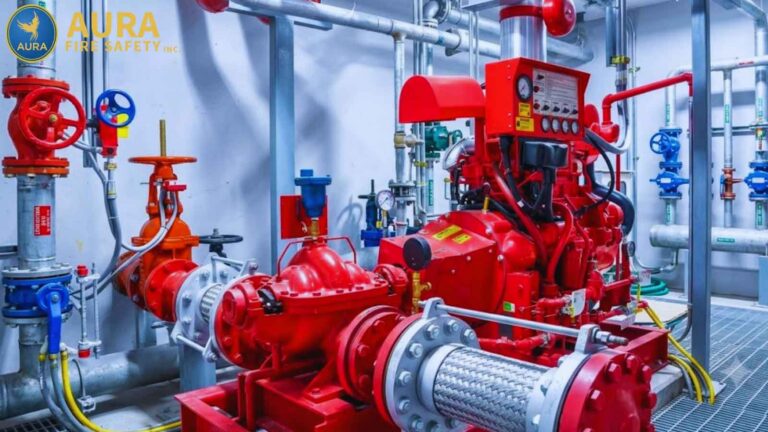
A fire pump room inspection covers more than the pump’s mechanical condition and performance. NFPA 25 Chapter 8 requires inspectors to evaluate the room’s environmental conditions, mechanical safeguards, controller status, and housekeeping compliance during every inspection visit. Deficiencies in any of these areas can result in the same impairment classification as a mechanical pump failure, and they are among the most commonly cited findings during fire department compliance audits. For property managers and building owners responsible for fire pump systems, understanding what gets checked beyond the pump itself is essential for avoiding violations. Aura Fire Safety provides fire pump maintenance and inspection services for commercial and multi-unit residential properties throughout the San Francisco Bay Area.
Get in Touch for Fire Protection Services
Why Does the Fire Pump Room Matter for Compliance?
The fire pump room matters for compliance because the pump’s ability to start and perform depends entirely on the conditions surrounding it. A pump that is mechanically sound but housed in a room that is too cold, flooded, improperly ventilated, or inaccessible is not a reliable fire protection asset. NFPA 25 recognizes this by including room condition checks as part of the standard inspection protocol, not as optional supplemental items.
The AHJ and local fire departments in the Bay Area evaluate fire pump rooms as part of their compliance inspections and may cite room deficiencies independently of pump performance. A citation for improper temperature maintenance or blocked access applies the same way a mechanical deficiency does. It requires documented correction within an assigned timeline, and impairments require immediate action and AHJ notification.
Property managers who address room conditions proactively during routine maintenance visits avoid the compressed timelines and higher correction costs that come with AHJ-driven notices of violation.
ALSO READ: Fire Pump Annual Flow Test: What the Three Test Points Measure
What Environmental Conditions Must a Fire Pump Room Maintain?
A fire pump room must maintain minimum temperature, proper drainage, and adequate ventilation at all times. These are not discretionary maintenance items. They are conditions required by NFPA 20 and NFPA 25 that inspectors verify at every visit.
Temperature
The fire pump room must be maintained at a minimum of 40°F (4°C) for electric motor-driven pump installations. Diesel engine-driven pump rooms require a minimum of 70°F (21°C) because diesel engines require warmer ambient temperatures to start reliably. Temperatures below these thresholds can cause system components to freeze, diesel fuel to gel, or battery performance to degrade to the point where the engine fails to crank.
During the inspection, the technician records the ambient room temperature. If the temperature is below the required minimum, the finding is documented as a deficiency and the building owner is required to address the heating system before the next inspection.
Floor Drainage
The pump room floor must be free of excessive standing water or unmanaged water accumulation. Minor dripping from pump packing glands is normal and expected. Packing glands require a small continuous drip to remain lubricated. The concern is standing water that could indicate a system leak, a drainage failure, or flooding from an external source.
Inspectors check that floor drains are clear and functional and that no water accumulation is present beyond what the packing glands produce. Excessive water on the floor can indicate a failing gland, a valve leak, or a piping issue that warrants further investigation.
Ventilation
Ventilation louvers, intake fans, and exhaust fans must operate freely without blockage or obstruction. Adequate ventilation serves two purposes: it helps maintain temperature within the required range and, for diesel pump rooms, removes exhaust gases produced when the engine runs during testing.
Blocked louvers are a common finding, particularly in rooms where the ventilation openings face exterior walls that accumulate debris. Inspectors check that all ventilation components move freely and that the airflow path through the room is unobstructed.
What Mechanical Safeguards Does an Inspector Check?
Mechanical safeguard checks focus on the physical components surrounding the pump that protect both the equipment and the personnel who access the room.
Coupling Guards
The coupling guard is the protective cage that covers the rotating shaft connecting the pump to its driver motor or engine. NFPA 25 requires the coupling guard to be in place and secure during all operating conditions. An absent or damaged coupling guard is a safety hazard and a compliance deficiency. Inspectors confirm the guard is present, properly secured, and undamaged.
Valve Positions and Supervision
All suction, discharge, and bypass valves associated with the fire pump must be in the fully open position and supervised. Supervised means the valve position is monitored by a tamper switch connected to the fire alarm panel. If the valve is moved from its required position, the fire alarm system generates a supervisory signal. Inspectors confirm each valve is open, that the tamper switch is functional, and that the supervisory signal reaches the fire alarm panel correctly.
A closed or partially closed suction valve is among the most serious findings possible in a fire pump room because it can prevent the pump from delivering water entirely. Any valve found out of position is treated as an impairment requiring immediate correction.
Pressure Gauges
Suction and discharge pressure gauges must be present, readable, and accurate. Inspectors verify that gauges are not damaged, fogged, or frozen, and that readings are within the expected range for normal standby conditions. Gauges outside the expected range may indicate a system pressure problem that warrants further investigation before the inspection is closed.
ALSO READ: What Is a Fire Pump Churn Test? A Guide for Building Owners
Get in Touch for Fire Protection Services
What Does the Fire Pump Controller Inspection Cover?
The fire pump controller inspection is a separate check from the mechanical inspection and covers the electrical and control components that start and manage the pump. NFPA 25 requires the controller to be inspected at each visit to confirm it is in automatic mode, showing no fault conditions, and ready to start the pump without manual intervention.
Inspectors check the following controller items:
- Controller mode: The controller must be in automatic mode. A controller left in manual mode after a previous test is a common finding and means the pump will not start automatically when the system pressure drops.
- Pilot light indicators: Most controllers have indicator lights showing power status, phase reversal, and alarm conditions. Inspectors confirm all indicators show normal operating status.
- Phase reversal: Three-phase electric motors will run backward if any two power phases are reversed. A phase reversal condition means the pump impeller rotates in the wrong direction and cannot deliver water. Inspectors confirm no phase reversal alarm is present.
- Alarm panel signals: The controller’s connection to the fire alarm panel is verified to confirm that pump start, pump run, and loss-of-power signals are transmitting correctly.
- Battery condition (diesel controllers): Diesel pump controllers use batteries to crank the engine. Inspectors check battery voltage and confirm the battery charger is functioning. Dead or low batteries occur frequently in rooms where the pump is tested infrequently — the charger may have failed without anyone noticing between visits.
What Housekeeping and Access Requirements Apply to Fire Pump Rooms?
Fire pump rooms must be kept clear of storage and clutter and must be accessible to inspectors and emergency personnel at all times. These requirements exist in NFPA 20, NFPA 25, and the California Fire Code, and they are among the most frequently cited violations during fire department compliance inspections.
The room cannot be used for general storage of building supplies, equipment, or any materials unrelated to the fire pump system. Items stored in the pump room create access obstructions, introduce ignition sources near electrical equipment, and can block the ventilation path. Inspectors document any storage present in the room as a deficiency requiring removal.
Access pathways must remain clear so that a technician or fire department inspector can reach the pump, controller, valves, and gauges without obstruction. Lighting must be fully functional. A pump room with burned-out lights cannot be safely inspected or serviced during an emergency. Inspectors check that all installed lighting is operational and that no temporary workarounds substitute for proper fixed lighting.
In San Francisco, SFFD compliance inspectors specifically cite pump room access and housekeeping violations during their building inspections, separate from the NFPA 25 inspection conducted by the fire protection contractor. A room that passes the contractor’s inspection but accumulates storage between visits may still receive an SFFD citation.
What Happens When a Fire Pump Room Fails Inspection?
When an inspector finds deficiencies in the fire pump room, the findings are documented in a written report and categorized by severity under NFPA 25. The same three-tier classification that applies to pump mechanical deficiencies applies to room condition findings.
Impairments are the most serious category. A closed suction valve, a controller in manual mode, or a room temperature below the minimum threshold can all be classified as impairments if they prevent the pump from performing its intended function. Impairments require immediate action and AHJ notification. A fire watch is required within 4 hours when a fire protection system is rendered unable to perform, per NFPA 25 impairment procedures.
Deficiencies are conditions that compromise the system but do not render it fully non-functional. Blocked ventilation, a missing coupling guard, or non-functional lighting are examples of deficiencies that require correction within an assigned timeline rather than immediate action. Observations are lower-priority items flagged for monitoring, such as minor housekeeping issues that do not yet constitute a blockage or storage violation.
Corrections must be completed and documented before the inspection record can be considered compliant. Aura Fire Safety handles identified corrections under the same contract as the inspection and confirms all deficiencies are resolved before closing the job. For a full overview of our services, visit our fire pump maintenance page.
Fire Pump Room Inspection Checklist
This checklist summarizes what inspectors verify beyond the pump itself during every NFPA 25-required fire pump room inspection. Use it as a reference for routine walkthroughs between scheduled contractor visits.
| Area | What Inspectors Check | Pass Condition |
| Temperature | Ambient room temperature recorded | 40°F minimum (electric); 70°F minimum (diesel) |
| Floor Drainage | Standing water or unmanaged accumulation | Floor clear of excess water; drains functional |
| Ventilation | Louvers, intake and exhaust fans | All components unobstructed and operating freely |
| Coupling Guard | Protective cage over pump-to-driver shaft | Guard present, secured, and undamaged |
| Suction Valve | Valve position and tamper switch function | Fully open; supervisory signal transmitting correctly |
| Discharge Valve | Valve position and tamper switch function | Fully open; supervisory signal transmitting correctly |
| Pressure Gauges | Suction and discharge readings | Readable, undamaged, within expected standby range |
| Controller Mode | Automatic vs. manual setting | Controller in automatic mode; no fault indicators |
| Phase Reversal | Electrical phase alignment | No phase reversal alarm present |
| Alarm Panel Signals | Pump start, run, and power-loss signal transmission | All signals transmitting to fire alarm panel correctly |
| Battery Condition | Battery voltage and charger function (diesel) | Battery charged; charger operational |
| Housekeeping and Access | Storage, lighting, and access pathways | Room clear of storage; lighting functional; pathways unobstructed |
Schedule Fire Pump Room Inspection in the Bay Area
Aura Fire Safety provides fire pump room inspections, churn testing, annual flow testing, and maintenance for commercial and multi-unit residential properties throughout the San Francisco Bay Area. Our licensed team documents all room condition findings alongside mechanical and controller checks in a single written report. Contact Aura Fire Safety to schedule service or request a quote.
Frequently Asked Questions
How often is a fire pump room inspection required?
Under NFPA 25, both diesel and electric fire pumps require weekly operational testing, meaning the room is evaluated weekly for both pump types during churn testing. Your local AHJ may apply different frequencies for electric pumps in specific configurations — confirm the required schedule with your licensed fire protection contractor. Full documentation of room conditions is also required during the annual flow test and 5-year certification visit.
Can building maintenance staff conduct the fire pump room inspection?
Building maintenance staff can and should perform their own daily or weekly visual checks of the pump room to catch obvious issues like standing water, storage accumulation, or temperature drops. However, the formal NFPA 25 inspection that generates documentation for AHJ compliance must be performed by a licensed fire protection contractor. Building staff observations do not substitute for documented contractor inspections.
What temperature is required in a diesel fire pump room?
Diesel fire pump rooms must maintain a minimum ambient temperature of 70°F (21°C). Electric pump rooms require a minimum of 40°F (4°C). The higher threshold for diesel rooms reflects the engine’s sensitivity to cold, which can cause fuel gelling and battery failure at lower temperatures.
Is the fire pump room inspection the same as the churn test?
No. The churn test evaluates the pump’s mechanical condition by running it under no-flow conditions. The room inspection evaluates the environment surrounding the pump: temperature, drainage, ventilation, lighting, housekeeping, valve positions, and controller status. Both are required at each inspection visit, but they address different aspects of fire pump readiness.
Get in Touch for Fire Protection Services