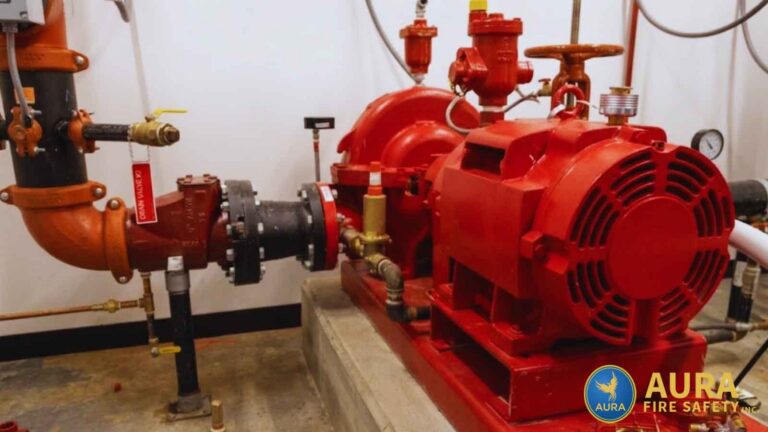
The annual fire pump flow test is a performance evaluation required by NFPA 25 that runs a fire pump under actual flow conditions to confirm it can deliver water at the pressure and volume the fire sprinkler system requires. Unlike the churn test, which runs the pump with no water discharge, the annual flow test opens discharge through test headers or a flow meter loop and measures pump output at three defined points: minimum flow, rated flow, and peak flow. Each point answers a different question about pump performance.
Get in Touch for Fire Protection Services
For property managers and building owners responsible for buildings with fire pump systems, understanding what these three points measure is the key to interpreting test results and knowing when a pump is performing correctly. Aura Fire Safety provides fire pump maintenance and annual flow testing for commercial properties throughout the San Francisco Bay Area.
What Is a Fire Pump Annual Flow Test?
A fire pump annual flow test is a comprehensive performance test required once per year under NFPA 25, Chapter 8. It evaluates whether a fire pump still performs to its design specification by measuring pressure and flow output at multiple operating conditions. The results are compared against the pump’s original factory acceptance test curve and any previous annual test data to identify degradation over time.
The test differs fundamentally from weekly or monthly churn testing. Churn tests confirm the pump starts and operates mechanically. They do not measure whether the pump can deliver sufficient water pressure and volume to protect the building. The annual flow test answers that question directly, making it the most comprehensive evaluation in the fire pump maintenance cycle.
ALSO READ: Emergency Fire Protection Services: How Aura Fire Safety Keeps You Safe
What Are the Three Test Points in an Annual Flow Test?
The three test points in an annual fire pump flow test are minimum flow, rated flow, and peak flow. Each point is measured at a specific flow rate and produces a pressure reading that is plotted against the pump’s performance curve. Together, the three points define the pump’s operating range and confirm it performs consistently across all expected demand conditions.
Minimum Flow
The minimum flow test point runs the pump at the lowest flow rate specified in NFPA 25. For electric-driven pumps, this is typically 150 percent of the rated pressure at shutoff, which the test approaches from the churn condition by opening discharge incrementally. The minimum flow point protects the pump from overheating during low-demand conditions. A pump that recirculates water internally without sufficient flow through the casing can overheat and damage internal components. Confirming adequate minimum flow verifies the pump can operate safely even when sprinkler demand is low.
Rated Flow
The rated flow test point is the most important of the three. It measures pump output at 100 percent of the rated flow capacity stamped on the pump nameplate. At this point, NFPA 25 requires the pump to deliver at least 100 percent of its rated pressure. The rated point represents the design condition the pump was engineered to meet, corresponding to the hydraulic demand of the building’s fire sprinkler system at its peak design flow. If the pump cannot deliver rated pressure at rated flow, the sprinkler system may not receive adequate water pressure during a fire event, which directly compromises the system’s ability to suppress fire.
Peak Flow
The peak flow test point runs the pump at 150 percent of its rated flow. At this flow rate, NFPA 25 requires the pump to deliver at least 65 percent of its rated pressure. The peak flow point tests the pump at its maximum expected demand condition, verifying it can handle surge demand without collapsing in pressure below an acceptable threshold. Buildings with multiple sprinkler zones or standpipe systems that could draw simultaneously benefit from confirming the pump performs acceptably at peak demand, not just at its rated design point.
ALSO READ: A Deep Dive into NFPA Compliance: What San Francisco Property Owners Need to Know
How Is the Annual Flow Test Performed?
The annual flow test requires flowing water from the pump discharge through approved test equipment to measure pressure and flow at each of the three test points. This is accomplished through one of two primary methods: discharge through hose streams from a test header located on the fire pump discharge piping, or through a closed-loop flow meter system piped between the pump discharge and suction.
The test header method flows water to the exterior of the building or into a drain system. The closed-loop method, also called a flow meter loop, recirculates water back to the pump suction and is used in buildings where exterior discharge is not practical. Both methods produce the same data when properly calibrated.
At each test point, a technician records suction pressure, discharge pressure, and flow rate. These readings are used to calculate differential pressure across the pump, which is the actual measure of pump output. The technician plots the three data points and compares them to the pump’s rated performance curve and the original factory acceptance test. The test also includes observation of mechanical condition, controller function, and all the items checked during a standard churn test, since the pump is operating under load throughout the flow test.
ALSO READ: How To Prepare For Fire Season In California
How Are Annual Flow Test Results Interpreted?
Test results are interpreted by comparing the measured performance curve against two reference points: the pump’s rated performance curve from the nameplate and factory documentation, and the most recent previous annual test data.
A pump performing well produces a curve that closely matches its rated curve across all three test points. Minor variation is expected and acceptable. A pump showing degradation produces a curve that falls below the rated curve, indicating reduced pressure output at one or more flow points. The critical threshold is the rated flow point. If the pump cannot deliver at least 100 percent of rated pressure at rated flow, it is considered to be underperforming relative to its design specification.
Get in Touch for Fire Protection Services
Gradual degradation identified year over year is often more valuable than any single test result. A pump that passes each individual annual test but shows a consistent downward trend across multiple years may be approaching a condition that warrants inspection of internal components, wear ring replacement, or impeller evaluation before a failure occurs. This is why NFPA 25 requires the annual test data to be compared against both the rated curve and the acceptance test, not just evaluated in isolation.
What Happens if a Fire Pump Fails an Annual Flow Test?
If a fire pump fails to meet the NFPA 25 performance thresholds at any of the three test points, the findings are documented in a deficiency report. The severity of the classification depends on how far performance has dropped and whether the pump can still provide meaningful protection.
A pump that fails to reach rated pressure at rated flow represents a deficiency that must be addressed. Depending on the degree of underperformance, the AHJ may require notification and correction within a defined timeline. A pump that fails severely, for example one that cannot maintain adequate pressure at minimum flow or shows signs of impeller damage or internal wear, may be classified as an impairment requiring immediate action.
Common causes of annual flow test failure include worn wear rings, impeller erosion, cavitation damage, internal recirculation caused by damaged components, and motor or diesel engine performance issues that prevent the driver from reaching full speed under load. Each of these requires a different corrective approach, and repairs must be performed by a licensed fire protection contractor before a follow-up test confirms the pump meets requirements.
For broader context on how the annual flow test fits into the complete fire pump maintenance schedule, including churn testing requirements, see our post on routine fire pump testing.
How Is the Annual Flow Test Different From a Churn Test?
The churn test and the annual flow test are complementary requirements, not alternatives. Understanding what each test does and does not measure helps building owners interpret their testing documentation accurately.
A churn test runs the pump at its shutoff condition with no water discharged. It confirms the pump starts, the controller sequences correctly, pressures reach shutoff levels, and no mechanical problems are present during operation. It does not measure how the pump performs when water is actually flowing through the system.
The annual flow test runs the pump under real discharge conditions and measures output across three flow points. It answers whether the pump can actually deliver the pressure and volume the fire sprinkler system requires. A pump can pass every churn test for years while gradually losing flow capacity due to internal wear, and the annual flow test is the only test that will catch that degradation.
NFPA 25 requires both. The churn test provides frequent confirmation of operational readiness between annual tests. The annual flow test provides the definitive performance evaluation that the churn test cannot. Together they ensure the pump is both operational and capable of protecting the building.
Schedule Your Annual Fire Pump Flow Test in the Bay Area
Aura Fire Safety provides annual flow testing, weekly and monthly churn testing, and 5-year comprehensive testing for fire pumps at commercial and multi-unit residential properties throughout the San Francisco Bay Area. All test results are documented in written reports with performance curve comparisons, and our team handles any deficiencies found under the same contract. Contact Aura Fire Safety online to schedule testing or request a quote.
Frequently Asked Questions
How long does an annual fire pump flow test take?
An annual flow test typically takes two to four hours depending on building access, pump configuration, and whether test headers or a flow meter loop are used. Additional time may be needed if deficiencies are found that require documentation or if corrections are made on the same visit.
Does the annual flow test affect the building’s fire sprinkler system?
Coordinating with the AHJ and building management before the test is advisable, since water will be discharged during the test and system pressure will fluctuate. In most cases the fire sprinkler system remains operable throughout the test, but the building should be aware that the pump will be running under load and system pressure conditions will not be at their normal standby level.
Who is qualified to perform an annual fire pump flow test?
A licensed fire protection contractor must perform and document the annual flow test. In California, the contractor must hold an active C-16 license. Aura Fire Safety holds C-16 license #1116233 and has provided fire pump testing services for Bay Area properties for over 27 years.
How does the 5-year fire pump test differ from the annual flow test?
The 5-year test is a comprehensive flow test that uses the same three test point methodology as the annual test but is compared specifically against the original factory acceptance test data rather than just the most recent annual test. Its purpose is to evaluate long-term performance degradation against the pump’s original design specification. NFPA 25 requires the 5-year test results to be formally compared to the acceptance test curve and documented accordingly.
Get in Touch for Fire Protection Services