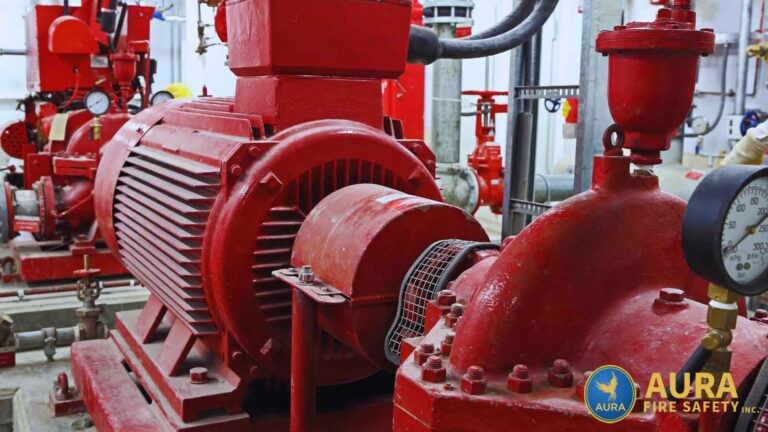
A fire pump churn test is a no-flow operational test that runs a fire pump at its shutoff condition to verify it starts correctly, reaches proper pressure, and shows no signs of mechanical problems. No water is discharged from the system during the test. The pump runs against closed discharge valves while a technician monitors pressure readings, controller functions, and physical condition. For property managers and building owners responsible for buildings with fire pump systems, understanding what this test involves and when it’s required is a fundamental part of fire protection compliance. Aura Fire Safety provides fire pump maintenance and testing services for commercial properties throughout the San Francisco Bay Area.
Get in Touch for Fire Protection Services
What Is a Fire Pump and Why Does It Need Testing?
A fire pump is a dedicated pumping system that boosts water pressure to supply a building’s fire sprinkler system when municipal water pressure alone is insufficient to meet the system’s hydraulic demand. High-rise buildings, large commercial complexes, and facilities served by a ground-level water storage tank commonly require fire pumps because the available supply pressure cannot reach the upper floors or meet peak flow requirements.
Fire pumps sit idle most of the time. They are not in continuous operation the way a domestic water pump might be. That dormancy creates a maintenance problem: components can seize, packing can dry out, diesel engine batteries can discharge, and fuel can degrade. A pump that appears functional but has never been tested may fail to start or fail to maintain pressure during an actual fire event. Regular testing is the only way to catch these problems before they matter.
ALSO READ: Preparing Your Building for a Fire Marshal Inspection
Why Is the Churn Test Required?
The churn test is required by NFPA 25, the standard governing the inspection, testing, and maintenance of water-based fire protection systems. NFPA 25 Chapter 8 specifies that fire pumps must be tested regularly under no-flow conditions to confirm operational readiness. The San Francisco Fire Department and local Authorities Having Jurisdiction (AHJ) throughout the Bay Area enforce this requirement and may request documentation of completed tests at any time.
The rationale is straightforward. A fire pump that has not been run recently may have internal corrosion, seized bearings, degraded packing, or electrical and mechanical faults that are invisible without operation. Running the pump under the churn test conditions exercises all of these components, confirms the controller sequences correctly, and allows a technician to observe the pump while it is operating rather than guessing at its condition from a visual inspection alone.
Failure to maintain churn test records can result in notices of violation from the AHJ, and a fire pump that fails during an actual emergency is a liability that no building owner wants to face.
How Often Does a Fire Pump Churn Test Need to Be Performed?
Under NFPA 25, the required frequency for churn testing depends on the pump’s driver type. Diesel-driven fire pumps must be run weekly. Electric motor-driven fire pumps are required to be tested monthly. Both test types follow the same no-flow churn procedure, but the frequency reflects the different maintenance demands of each driver type. Diesel engines require more frequent operation to keep batteries charged and fuel systems active.
A licensed fire protection contractor must perform and document these tests. Property managers and building owners are responsible for ensuring the tests are scheduled on time and that records are maintained. The AHJ may request the complete testing log at any inspection. Aura Fire Safety provides scheduled churn testing for both diesel and electric fire pumps as part of our fire pump maintenance program throughout the Bay Area.
ALSO READ: The 5 Most Common Fire Inspection Failures (And How to Fix Them)
What Do Technicians Check During a Churn Test?
During a fire pump churn test, a technician starts the pump and allows it to reach operating condition, then monitors a specific set of parameters for the required run duration. Electric pumps run for a minimum of ten minutes. Diesel pumps run for a minimum of thirty minutes. Throughout the test, the technician documents findings against the requirements of NFPA 25.
The items checked during a churn test include:
- Pump start: Confirms the pump starts automatically on pressure drop or can be started manually without issue.
- Suction and discharge pressure: Readings are taken at shutoff condition and compared to the pump’s rated performance curve and previous test data.
- Packing glands: Checked for appropriate drip rate. A small amount of dripping is normal and keeps the gland lubricated. Excessive leakage or no drip indicates a packing problem.
- Controller functions: The fire pump controller is checked for proper sequencing, alarm conditions, and any fault indicators on the panel.
- Pump and motor condition: Technicians listen and observe for unusual vibration, overheating, bearing noise, or any signs of mechanical distress.
- Diesel engine specifics (if applicable): Battery voltage, oil level, coolant level, fuel level, and exhaust condition are checked. The engine must start within the required number of cranking cycles.
- Jockey pump operation: The jockey pump (pressure maintenance pump) is observed to confirm it is cycling as expected and not running continuously, which would indicate a system leak.
After the run period, the pump is shut down, observations are recorded, and any deficiencies found during the test are documented in a written report.
What Happens if a Fire Pump Fails a Churn Test?
If a fire pump fails to start, fails to reach shutoff pressure, or shows signs of mechanical or electrical problems during a churn test, the findings are documented in a deficiency report. NFPA 25 categorizes deficiencies as impairments, deficiencies, or observations depending on severity.
Get in Touch for Fire Protection Services
An impairment means the system cannot function as intended. A fire pump that fails to start is an impairment and requires immediate action. The AHJ must be notified, and depending on the duration and scope of the impairment, a fire watch may be required under NFPA 101 while the pump is out of service. Less severe findings are classified as deficiencies or observations and are assigned correction timelines based on the risk they present.
Repairs following a churn test failure might include repacking the pump, replacing controller components, servicing the diesel engine, or replacing worn impeller components. All repair work must be performed by a licensed fire protection contractor, and a follow-up test confirms the pump meets requirements after corrections are made. For broader context on the full fire pump testing schedule, including annual flow testing and 5-year requirements, see our post on why routine fire pump testing is required.
How Is a Churn Test Different From an Annual Fire Pump Flow Test?
The churn test and the annual flow test are both required by NFPA 25, but they measure different things and serve different purposes.
A churn test runs the pump with all discharge valves closed so no water flows. It tests whether the pump starts, operates mechanically, and reaches shutoff pressure. It does not measure how the pump performs under actual flow conditions. This is why it can be completed quickly and without discharging water from the system.
An annual flow test runs the pump at multiple flow points, including minimum flow, rated flow, and peak flow, using test headers or a flow meter loop to discharge water and measure performance. The results are plotted against the pump’s rated performance curve and its original factory acceptance test data. The annual test answers whether the pump can actually deliver water at the pressure and volume the fire sprinkler system requires. A churn test cannot answer that question.
Both tests are required. The churn test is more frequent and confirms operational readiness between annual tests. The annual flow test confirms the pump still performs to its design specification. Together they provide a complete picture of fire pump health throughout the year.
ALSO READ: Emergency Fire Protection Services: How Aura Fire Safety Keeps You Safe
Schedule Your Fire Pump Churn Testing in the Bay Area
Aura Fire Safety provides weekly and monthly churn testing, annual flow testing, and 5-year comprehensive testing for fire pumps at commercial and multi-unit residential properties throughout the San Francisco Bay Area. Our team documents all test findings in written reports, flags deficiencies, and coordinates corrections under the same contract. Contact Aura Fire Safety online to schedule testing or request a quote.
Frequently Asked Questions
Does the fire pump need to be shut down to the building during a churn test?
No. A churn test runs the pump in a no-flow condition with all discharge valves closed, so the building’s fire sprinkler system remains pressurized and operational throughout the test. There is no impairment to the fire protection system during a properly conducted churn test.
Who is responsible for scheduling fire pump churn tests?
The building owner or property manager is responsible for ensuring fire pump churn tests are performed on schedule and that records are maintained. A licensed fire protection contractor must perform the tests. Responsibility cannot be delegated to a tenant.
Can churn test records be requested by the fire department?
Yes. The SFFD and local AHJs throughout the Bay Area can request fire pump testing documentation during inspections. NFPA 25 requires that records of all testing be maintained and made available to the AHJ on request. Missing or incomplete records can result in notices of violation.
What is the difference between a jockey pump and a fire pump?
A fire pump is the main pump that delivers high-pressure water to the sprinkler system during a fire event. A jockey pump, also called a pressure maintenance pump, is a smaller pump that keeps the system pressurized during normal conditions to prevent the main fire pump from cycling on minor pressure fluctuations. The jockey pump runs frequently; the main fire pump is designed to start only when a significant pressure drop occurs, such as when a sprinkler head activates.
Get in Touch for Fire Protection Services