
A building needs a fire pump when the available municipal water pressure and flow cannot meet the hydraulic demand of the fire sprinkler system. The requirement is not based on a single universal rule. It is determined by a combination of building height, occupancy type, system design, and the results of a water supply flow test. For property managers and building owners in the San Francisco Bay Area, understanding what triggers the requirement and what it means for ongoing compliance is a practical necessity. Aura Fire Safety provides fire pump maintenance and testing services for commercial and multi-unit residential properties throughout the Bay Area.
Get in Touch for Fire Protection Services
What Does a Fire Pump Do?
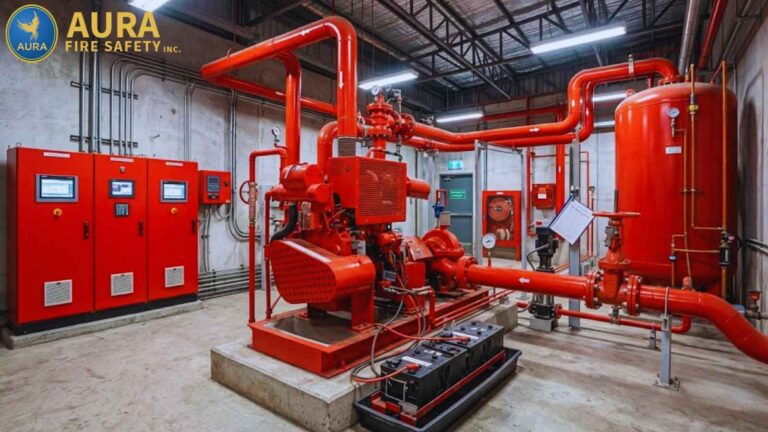
A fire pump boosts water pressure to supply a fire sprinkler system when the available water supply cannot deliver sufficient pressure and flow on its own. Without adequate pressure, sprinkler heads cannot discharge water at the volume and coverage required to suppress a fire effectively. The pump takes water from the municipal supply or an on-site storage tank and pressurizes it to meet the system’s design requirements.
Fire pumps are governed by NFPA 20, the standard for the installation of stationary pumps for fire protection. NFPA 20 covers pump selection, installation, controller requirements, and the acceptance testing process. NFPA 20 governs installation; NFPA 25 governs ongoing maintenance and testing.
ALSO READ: What to Do After a Failed Fire Alarm Inspection: Correction Timelines and Next Steps
When Is a Fire Pump Required by Code?
Three primary conditions trigger the fire pump requirement under NFPA 20 and the California Fire Code.
Insufficient Municipal Water Pressure
The most common trigger is a simple pressure shortfall. A fire protection engineer conducts a water supply flow test at the property’s connection point to measure static pressure, residual pressure, and available flow. If the test shows the available supply falls short of what the sprinkler system’s hydraulic calculations require, including the required safety margin, a fire pump is mandatory to make up the difference. This applies regardless of building height.
Building Height and Elevation
As buildings rise in height, gravity reduces the effective pressure available at upper floors. Municipal water pressure that is sufficient for a low-rise building may be completely inadequate for the upper floors of a mid-rise or high-rise structure. The exact elevation at which a pump becomes necessary depends on the building’s design, the local water pressure, and the hydraulic demand of the system.
In California, high-rise buildings are defined as structures with occupied floors more than 55 feet above the lowest level of fire department vehicle access. Buildings meeting this definition virtually always require fire pumps because municipal pressure cannot reach upper-floor standpipes and sprinkler systems without supplemental pressure.
On-Site Water Storage
Buildings that rely on a ground-level or below-grade water storage tank for their fire protection supply always require a fire pump. The tank provides the water volume, but it cannot provide pressure on its own. The pump draws from the tank and delivers pressurized water to the sprinkler system and standpipes. This configuration is common in areas where municipal supply pressure or reliability is insufficient to serve as the primary fire protection water source.
ALSO READ: Who is Responsible and What’s Required for Fire Alarm Inspections in Multi-Tenant Buildings?
Does Building Height Determine Whether a Fire Pump Is Needed?
Building height is a strong indicator but not a standalone determinant. Height influences hydraulic demand, and it is the hydraulic demand calculation, not the height measurement itself, that drives the code requirement.
That said, height is the most reliable predictor in practice. Every additional floor reduces available water pressure at the upper level by approximately 0.43 psi per foot of elevation. A building with 80 feet of elevation requires roughly 34.4 psi more pressure at the ground connection just to offset gravity, before accounting for friction losses in the piping or the system’s actual flow demand. Most municipal supplies cannot absorb that loss and still meet the sprinkler system’s minimum pressure requirements at the topmost sprinkler.
In San Francisco, where older infrastructure means variable water pressure across neighborhoods, even mid-rise buildings occasionally require pumps when local supply pressure is lower than typical. The only way to confirm whether a specific building needs a pump is a water supply flow test at the actual service connection, combined with the hydraulic calculations for the proposed or existing sprinkler system. No height threshold substitutes for that analysis.
What Happens During a Hydraulic Demand Analysis?
A hydraulic demand analysis is the engineering process that determines whether a fire pump is required and, if so, what its rated capacity must be. It is performed by a licensed fire protection engineer and produces the documentation required by the AHJ for plan review and permit approval.
Get in Touch for Fire Protection Services
The analysis involves two parallel calculations. The first is the system demand: the total pressure and flow the sprinkler system requires at its design point. This includes friction losses through all piping, elevation pressure loss, and the minimum residual pressure required at the most hydraulically remote sprinkler head. The second is the supply available: the actual pressure and flow delivered by the municipal water main at the building’s service connection, measured through a hydrant flow test.
If the supply curve and the demand curve intersect at an acceptable operating point, no pump is required. If they do not, the gap between available supply and system demand defines the pump’s required rated capacity. NFPA 20 then governs which pump configuration meets that requirement, and the AHJ approves the final design before installation.
For building owners acquiring existing properties, confirming whether a fire pump was required by the original design and whether it is properly maintained is part of due diligence. A pump that was required but never installed, or one that is installed but out of compliance with NFPA 25 testing requirements, represents a significant liability.
ALSO READ: How Long Does a Fire Alarm Inspection Take? What Property Managers Should Plan For
What Are a Building Owner’s Fire Pump Compliance Obligations?
Once a fire pump is installed, the building owner or property manager is responsible for maintaining it on the schedule required by NFPA 25. The pump must be tested regularly to confirm it starts, operates correctly, and still meets its rated performance curve. A pump that passes visual inspection but has never been run may fail to start or maintain pressure in an actual fire event.
NFPA 25 Chapter 8 requires three levels of testing:
- Weekly churn tests (diesel) / Monthly churn tests (electric): No-flow operational tests confirming the pump starts and operates correctly.
- Annual flow test: Performance tested at three flow points and compared against the pump’s rated curve.
- 5-year comprehensive flow test: Performance compared against the original factory acceptance test to identify long-term degradation.
The San Francisco Fire Department and local AHJs throughout the Bay Area enforce these schedules and may request testing records at any inspection. Missing or incomplete records can result in notices of violation regardless of the pump’s actual condition. For more on what each test involves, see our post on fire pump testing requirements.
Schedule Fire Pump Service in the Bay Area
Aura Fire Safety provides fire pump testing, inspection, and maintenance for commercial and multi-unit residential properties throughout the San Francisco Bay Area. Our licensed team handles weekly churn testing, annual flow testing, 5-year certifications, and repairs under one contract. Contact Aura Fire Safety to schedule service or request a quote.
Frequently Asked Questions
Does every commercial building need a fire pump?
No. A fire pump is only required when the available water supply cannot meet the hydraulic demand of the fire sprinkler system. Many low-rise commercial buildings with adequate municipal pressure do not require a fire pump. The determination is made through a water supply flow test and hydraulic demand analysis, not a general rule about building type.
Who determines whether a building needs a fire pump?
A licensed fire protection engineer performs the hydraulic demand analysis and water supply flow test that determines whether a pump is required. The local AHJ reviews and approves the determination as part of the building’s fire protection plan review. Building owners cannot self-determine whether a pump is required without this engineering analysis.
Can a building’s fire pump requirement change over time?
Yes. If a building’s occupancy changes, a tenant improvement adds more sprinkler heads, or the local water supply pressure decreases, the hydraulic demand of the system may increase beyond what the existing supply can meet. Tenant improvements that modify the fire sprinkler system should always be evaluated by a fire protection engineer to confirm the existing water supply still meets the revised system demand.
What is the difference between a fire pump and a jockey pump?
A fire pump is the main pump that boosts water pressure to supply the fire sprinkler system during a fire event. A jockey pump, also called a pressure maintenance pump, is a smaller pump that keeps the system pressurized during normal conditions to prevent the main fire pump from cycling on minor pressure fluctuations. The jockey pump runs frequently; the main fire pump is designed to start only when a significant pressure drop occurs, such as when a sprinkler head activates.
Get in Touch for Fire Protection Services