A failed fire alarm inspection means one or more system components did not meet NFPA 72 standards, and the building’s fire alarm certification cannot be renewed until the documented deficiencies are corrected and verified through re-inspection. The AHJ sets the correction deadline based on severity, with critical safety items requiring immediate action and minor items allowing 30 days or longer. For property managers and building owners working through an active deficiency report, the fire alarm inspection report is the starting point: it identifies exactly what failed, the code reference, and the recommended correction.
What Does It Mean to Fail a Fire Alarm Inspection?
A failed fire alarm inspection means one or more components did not meet NFPA 72 testing standards, documented as deficiencies in the inspection report. The system cannot be certified until those items are corrected and verified.
NFPA 72 (2022 edition) classifies inspection findings into three categories:
- Impairment: the system or a major portion cannot perform its intended function. Examples include the panel offline, all backup batteries failed, or monitoring connection lost. Impairments require immediate action and often trigger a temporary fire watch.
- Deficiency: a specific component does not meet code, but the system as a whole can still function. Examples include one detector outside sensitivity range, a single horn below required decibel level, or a missing inspection tag. Deficiencies are further classified as critical (material impact on system performance) or non-critical (does not affect performance but must be corrected).
- Observation: a suggestion or improvement that does not currently qualify as a deficiency. Observations are advisory and do not require correction.
Most inspection reports flag a mix of critical deficiencies, non-critical deficiencies, and observations. The classification drives the AHJ’s correction timeline, the cost of repairs, and whether the building’s certification can be renewed on schedule.
What Are the Most Common Fire Alarm Inspection Failures?
The most common failures fall into four operational categories: detection devices, notification appliances, power supplies, and panel functions.
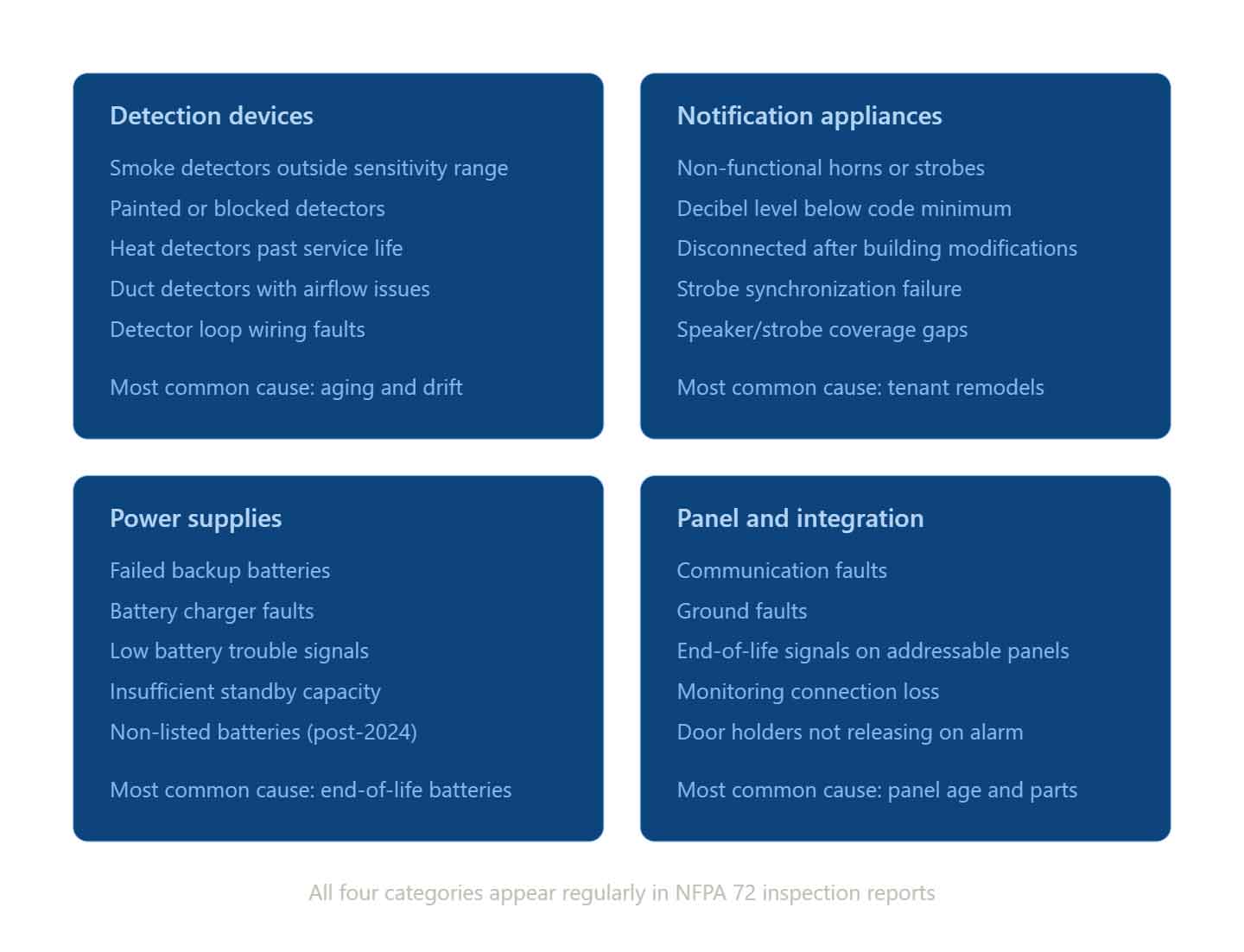
The pattern is consistent across building types. Detection failures usually come from aging devices or sensitivity drift. Notification failures come from disconnected or damaged appliances after building modifications. Power failures come from batteries reaching end-of-life without proactive replacement. Panel failures often signal a deeper system issue that needs technical investigation. For deeper detail on each failure type, see the post on common fire alarm inspection failures and how to fix them.
What Are the Correction Timelines After a Failed Inspection?
Correction deadlines are set by the AHJ in the deficiency report or Notice of Violation, with critical safety items requiring immediate action and minor items allowing 30 days or longer. NFPA 72 does not prescribe specific timelines; the deadline depends on the AHJ’s classification of severity and local enforcement practice.
| Severity | Common AHJ Practice | Examples |
| Impairment | Immediate (24–72 hours) plus interim fire watch | Panel offline, monitoring disconnected, all batteries failed |
| Critical deficiency | 30 days | Multiple non-functional notification appliances, failed door holders, sensitivity failures across detectors |
| Non-critical deficiency | 30–90 days | Single detector outside sensitivity range, one failed notification appliance, low battery |
| Observation / minor | Next inspection cycle | Documentation gaps, signage, missing inspection tags |
Some San Francisco Bay Area jurisdictions impose tighter windows on multi-unit residential properties or high-occupancy buildings. Failure to meet the deadline escalates to administrative citations, daily fines, and in serious cases, occupancy restrictions. For more on avoiding the violation chain entirely, see the guide on how to avoid a fire alarm violation notice.
How Does the Correction and Re-Inspection Process Work?
The correction and re-inspection process follows five steps from receiving the deficiency report through filing the updated certification with the AHJ:
- Review the deficiency report with the inspection company. Clarify scope, code references, and which items are impairments vs. deficiencies vs. observations. Not every item on the report requires the same urgency.
- Get a correction quote from a licensed C-10 fire alarm contractor. The inspecting contractor can usually provide this directly, though building owners may obtain quotes from other licensed contractors.
- Schedule and complete the repairs. This may include parts ordering for obsolete components, panel programming changes, and battery replacement. Coordinate with the monitoring company to place the system on test mode during work.
- Schedule re-inspection to verify all corrections meet NFPA 72 standards. The re-inspection can be performed by the original contractor or a different licensed contractor.
- File the updated certification with the AHJ to close the deficiency record. This step closes the violation file and resets the inspection clock.
For a closer look at what corrections typically involve, see the post on common fire alarm correction issues and how we fix them.
How to Prevent Future Fire Alarm Inspection Failures
Most fire alarm failures are preventable through monthly visual checks by building staff, quarterly battery testing, immediate response to panel trouble signals, and pre-inspection walk-throughs. Building a prevention routine into property management operations costs far less than working through an active failure.
Practical prevention steps:
- Monthly visual inspection of the FACP for trouble signals and battery condition
- Quarterly battery checks and replacement on a rolling schedule before end of life
- Immediate response to any trouble signal, supervisory signal, or fault indication on the panel
- Schedule annual inspections 30–60 days before the certification expiration to leave time for any corrections
- Keep spare batteries and common notification appliance parts on hand for fast correction
- Pre-inspection walk-through to identify obvious issues (painted devices, blocked notification appliances, missing tags)
- Maintain a building file with prior inspection reports, correction history, and AHJ correspondence
For deeper detail on the fire alarm system components that drive most inspection failures, see the service overview.
Whether working through an active deficiency report or setting up a recurring schedule that prevents the next one, Aura Fire Safety handles inspections, corrections, and AHJ filings across the San Francisco Bay Area. Contact us to schedule an inspection or corrections.
Frequently Asked Questions
Does a failed inspection mean my building is unsafe?
Not necessarily. A deficiency report may flag items that need correction without meaning the system is non-functional. Impairments (panel offline, all batteries failed, monitoring disconnected) do affect safety and require immediate action, often with an interim fire watch. Non-critical deficiencies usually mean specific components need attention while the system as a whole still functions.
How much do fire alarm corrections cost?
Correction costs depend on the type and number of deficiencies, parts availability, and whether the work requires panel programming or just device replacement. Battery replacement is typically a low-cost correction; addressable panel parts and obsolete components can be significantly higher. Request a written quote from your fire alarm contractor before scheduling work.
Can I use a different company for corrections than the one that inspected?
Yes. The contractor that performed the inspection often quotes the corrections, but the building owner is free to obtain quotes from other licensed C-10 fire alarm contractors. The re-inspection can be performed by any qualified contractor, and the updated certification is filed with the AHJ regardless of who completed the work.
Will my insurance be affected by a failed inspection?
Insurance carriers commonly track fire protection compliance as a condition of coverage. A documented failed inspection on the record can affect premium pricing at renewal and may be reviewed during claims investigation. Specific coverage questions belong with your carrier or broker.
How long does a re-inspection take?
A re-inspection typically takes a few hours to a full day depending on building size and the scope of items being verified. Scheduling depends on the contractor’s availability and the AHJ’s filing requirements. Most re-inspections can be completed within two to four weeks of the corrections being finished.