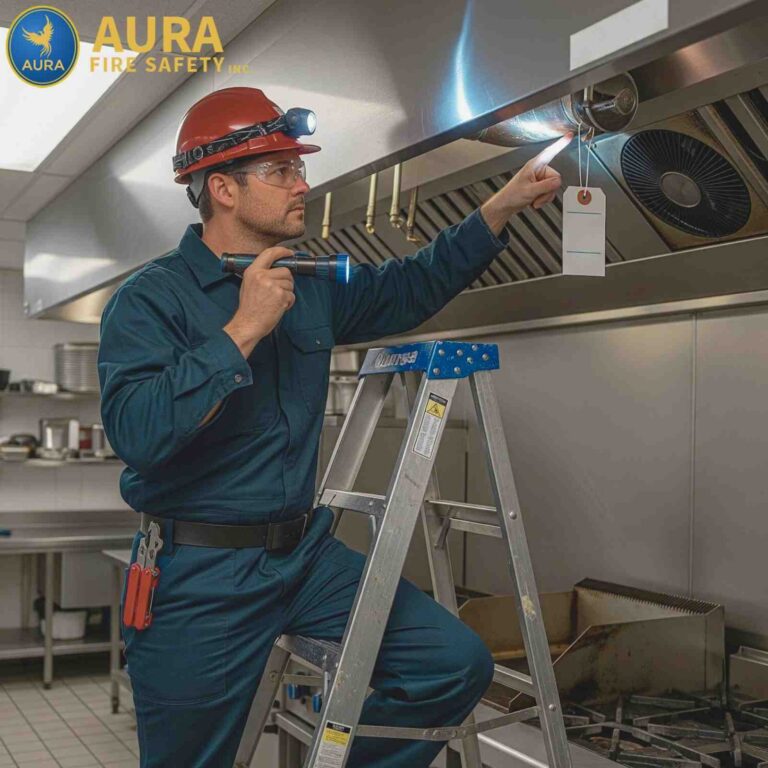
A semi-annual kitchen hood inspection covers every component of your kitchen hood fire suppression system, from the wet chemical agent cylinder to each individual discharge nozzle. A licensed technician verifies that the system can detect a fire, suppress it with a wet chemical agent, and shut off fuel or power to cooking equipment. This guide breaks down each checkpoint so restaurant owners, property managers, and kitchen operators know exactly what to expect.
Why California Requires Kitchen Hood Inspections Every 6 Months
California mandates semi-annual kitchen fire system service for all commercial cooking operations with hood-mounted suppression systems. The requirement reflects the high-risk environment of commercial kitchens, where grease accumulation and open flames create conditions that standard water-based sprinklers cannot address. Two inspections per year allow technicians to catch wear, grease buildup, and mechanical issues before they compromise the system’s ability to respond.
What Standards Apply to Kitchen Hood Fire Suppression Inspections?
Three primary standards govern kitchen hood fire suppression inspections in California. NFPA 17A (National Fire Protection Association Standard for Wet Chemical Extinguishing Systems) sets the baseline for inspection, testing, and maintenance procedures. NFPA 96 (Standard for Ventilation Control and Fire Protection of Commercial Cooking Operations) addresses the broader kitchen environment, including hood and ductwork requirements.
UL 300, published by Underwriters Laboratories, is the fire testing standard that all current kitchen hood suppression systems must meet. Systems manufactured before 1994 may not carry UL 300 certification. Your local Authority Having Jurisdiction (AHJ), typically the city fire marshal or fire prevention bureau, enforces these standards and may add requirements specific to your municipality.
Key Components Checked During a Semi-Annual Inspection
The inspection covers the full suppression system, not just the hood itself. A technician examines mechanical, chemical, and electrical components to confirm the system can activate, discharge agent, and shut down cooking equipment as designed.
Wet Chemical Agent Cylinder
The cylinder holds the potassium-based wet chemical agent that suppresses grease fires through a process called saponification. During the inspection, the technician weighs the cylinder and compares the reading to the manufacturer’s specified weight. A drop in weight may indicate a slow leak or partial discharge.
The technician checks the cylinder’s pressure gauge, hydrostatic test date, and overall physical condition. Cylinders that fall below the required agent weight or show signs of corrosion are flagged for recharge or replacement. This single component is the system’s primary means of fire suppression, so accurate agent levels are non-negotiable.
Discharge Nozzles and Detection Line
Each discharge nozzle sits directly above a cooking appliance and aims for a wet chemical agent at the cooking surface below. The technician confirms that every nozzle is properly aligned, free of grease obstruction, and positioned according to the manufacturer’s specifications. Kitchens that have rearranged appliances since the last inspection often have nozzles that no longer point at the correct target.
The detection line runs above the cooking area and connects each nozzle to the system’s activation mechanism. Technicians inspect the full length of this line for kinks, corrosion, grease coating, or physical damage. A compromised detection line can delay or prevent system activation.
Fusible Links and Heat Sensors
Fusible links are small metal connectors designed to melt at a specific temperature, typically between 280°F and 360°F. When a fusible link melts, it triggers the suppression system. The technician inspects each link for grease buildup, corrosion, or deformation that could affect the melting point.
Most manufacturers and NFPA 17A require fusible link replacement at least once per year, and some AHJs require replacement at every semi-annual service. The technician documents each link’s condition and replaces any that show signs of wear. Facilities using electronic heat sensors instead of fusible links receive a functional test of each sensor during the inspection.
ALSO READ: Preparing Your Building for a Fire Marshal Inspection
How Automatic Shutoffs and Manual Controls Are Tested
A kitchen hood suppression system does more than discharge wet chemical agents. It must simultaneously cut fuel and power to cooking equipment and alert building occupants. Technicians test each of these functions individually during the semi-annual service.
Gas and Electric Shutoff Connections
When the suppression system activates, it sends a signal to shut off the gas supply and electrical power to all protected cooking appliances. The technician tests this connection by simulating activation and confirming that each shutoff responds. A failed shutoff means cooking equipment could continue operating during a fire, feeding the flames even as the system attempts to suppress them.
The technician inspects the physical wiring and gas valve connections for loose fittings, corrosion, or tampering. Kitchens that have added or moved gas lines since the last inspection may need the shutoff connections reconfigured. The inspection report documents the status of each shutoff point.
Manual Pull Station and Control Panel
Every kitchen hood fire suppression system includes a manual pull station, usually mounted near an exit path from the kitchen. The technician confirms the pull station is accessible, clearly labeled, and not blocked by equipment or storage. A functional test verifies that pulling the station triggers the system.
The control panel ties the suppression system to the building’s fire alarm system. During the inspection, the technician confirms that system activation sends the correct signal to the fire alarm panel. This connection notifies the monitoring station and alerts occupants throughout the building.
Does the Inspection Require Shutting Down the Kitchen?
Most semi-annual inspections do not require a full kitchen shutdown. Technicians can perform the visual inspection, agent cylinder check, and nozzle review with cooking equipment still in place. Certain tests, such as the gas shutoff verification and manual pull station activation, do require brief pauses in cooking activity.
A typical approach is to schedule the inspection during a low-volume period, such as mid-morning before the lunch rush. The technician coordinates with the kitchen manager to minimize disruption. Plan for 15 to 30 minutes of reduced kitchen activity during the shutoff and pull station tests.
ALSO READ: How Aura Fire Safety Ensures Compliance and Avoids Costly Fire Code Violations
Common Issues Found During Kitchen Hood Inspections
Not every inspection results in a clean pass. Technicians regularly document deficiencies that need correction before the system can be certified. The table below outlines the most frequent findings.
| Issue | What It Means | What Happens Next |
| Grease-blocked nozzles | Agent cannot reach the cooking surface | Nozzles cleaned or replaced |
| Expired or corroded fusible links | Links may not melt at the correct temperature | Links replaced during the service visit |
| Low agent weight | Cylinder may not have enough agent to suppress a fire | Cylinder recharged or replaced |
| Misaligned nozzles | Agent sprays away from the cooking surface | Nozzles repositioned per manufacturer specs |
| Disconnected gas/electric shutoff | Cooking equipment stays on during activation | Shutoff connections repaired and retested |
| Obstructed manual pull station | Staff cannot reach the pull station in an emergency | Obstruction removed; station relocated if needed |
What Happens If My Kitchen Hood System Fails Inspection?
The technician documents each deficiency in a written inspection report and classifies it by severity. Minor issues, such as a single grease-blocked nozzle, can often be corrected on the same visit. Larger problems, such as a low-weight agent cylinder or disconnected shutoffs, may require a follow-up service call with replacement parts.
Until all deficiencies are resolved, the system cannot receive a passing certification tag. Your local fire marshal or health department may request proof of a valid certification during routine inspections. Addressing deficiencies promptly avoids re-inspection fees and keeps your kitchen in compliance with local requirements.
Monthly Visual Checks vs. Professional Semi-Annual Service
Restaurant owners and kitchen managers are responsible for monthly visual checks between professional service visits. These checks take only a few minutes and help catch obvious problems early. The table below shows what falls under each category.
| Task | Monthly Owner Check | Semi-Annual Professional Service |
| Nozzle condition | Confirm nozzles are visible and not capped with grease | Full cleaning, alignment, and positioning verification |
| Manual pull station | Confirm station is accessible and labeled | Functional activation test |
| Agent cylinder | Check pressure gauge is in the green range | Weigh cylinder and compare to manufacturer specification |
| Fusible links | Visual check for obvious damage or heavy grease | Inspect, test, and replace per NFPA 17A schedule |
| Gas/electric shutoffs | Confirm shutoff valves are in place | Simulate activation and verify response |
| Documentation | Log the date and any observations | Full written report with certification tag |
Who Is Qualified to Perform a Semi-Annual Kitchen Hood Inspection?
Semi-annual inspections must be performed by a licensed fire protection contractor with training specific to wet chemical suppression systems. In California, the contractor holds a C-16 (Fire Protection) license and operates under a State Fire Marshal registration. General maintenance staff and hood cleaning crews are not qualified to certify the system.
The technician follows the manufacturer’s service manual for the specific system brand and model. Different manufacturers may have slightly different procedures, nozzle configurations, and agent specifications. Always verify that your service provider has experience with the exact system installed in your kitchen.
Is a Semi-Annual Inspection the Same as a Hood Cleaning?
No. A semi-annual inspection and a hood cleaning are two separate services that address different parts of the kitchen exhaust system. Hood cleaning removes grease buildup from the interior surfaces of the hood, ductwork, and exhaust fan. A semi-annual inspection focuses entirely on the fire suppression system mounted inside and above the hood.
Both services are required for commercial kitchens, and both operate on their own schedules. Hood cleaning frequency depends on cooking volume and grease output, ranging from monthly to quarterly for most restaurants. The semi-annual suppression system inspection follows a fixed every-6-months cycle under California Fire Code and NFPA 17A.
How to Prepare Your Kitchen for a Semi-Annual Inspection
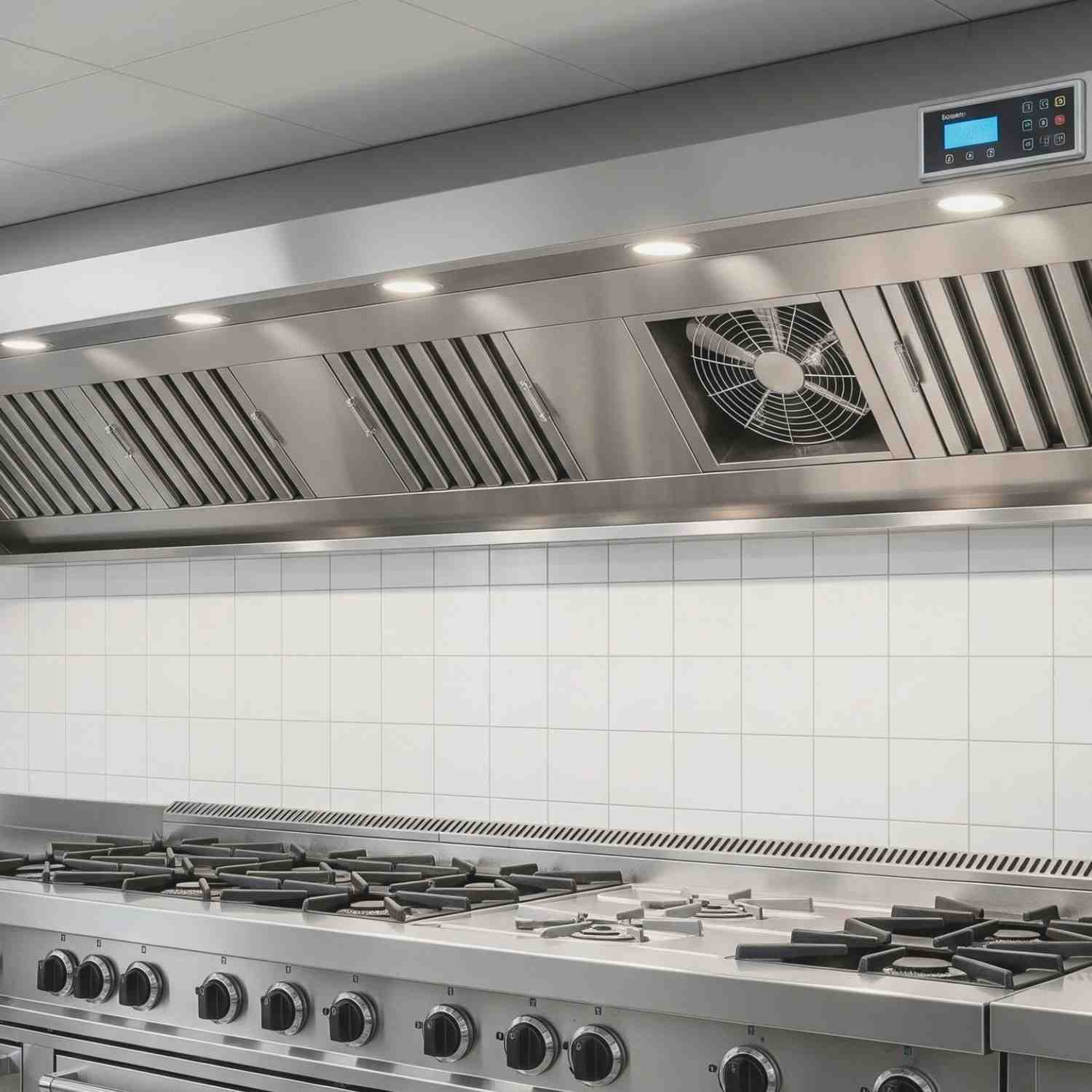
A small amount of preparation helps the inspection go smoothly and reduces the chance of avoidable deficiencies. Complete these steps before your technician arrives:
- Clear access to the manual pull station and agent cylinder
- Wipe visible grease from around nozzle caps and the detection line
- Gather the previous inspection report and certification tag
- Note any changes to your kitchen layout, such as new or moved appliances
- Inform kitchen staff of the scheduled service and any brief pauses in cooking
- Confirm that gas shutoff valves are accessible and not blocked by storage
How Long Does a Semi-Annual Kitchen Hood Inspection Take?
A standard semi-annual inspection takes between 45 minutes and 2 hours, depending on the size of the system and the number of cooking appliances protected. A small restaurant with a single hood line and 4 to 6 nozzles typically falls on the shorter end. Larger operations with multiple hood lines, separate cooking stations, and dozens of nozzles require more time.
If the technician finds deficiencies that can be corrected on-site, the visit may extend by 30 to 60 minutes. Complex repairs that require parts ordering are scheduled as a separate follow-up visit. Ask your service provider for a time estimate based on your specific system layout when you book the appointment.
Schedule Your Kitchen Hood Inspection with Aura Fire Safety
Aura Fire Safety provides semi-annual kitchen hood fire suppression system inspections for restaurants, hotels, cafeterias, and commercial kitchens across the San Francisco Bay Area. With over 27 years of experience and a State Fire Marshal registration (E 2336), our licensed technicians inspect, certify, and service all major system brands. Contact Aura Fire Safety to schedule your next semi-annual kitchen hood inspection or to ask questions about your system’s specific requirements.