
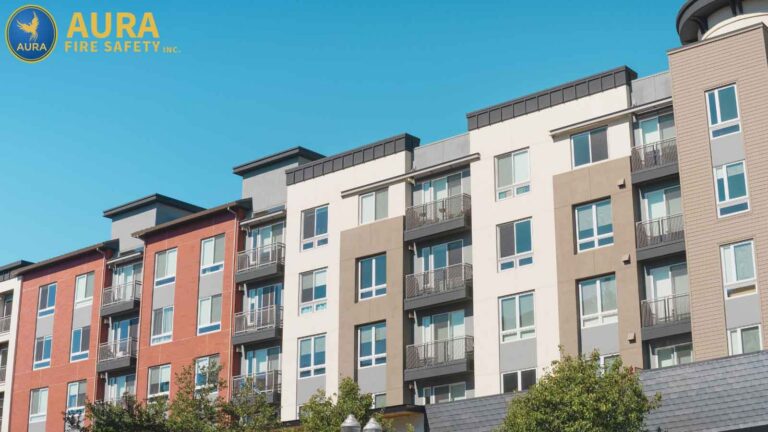
Multi-family property fire protection covers a coordinated set of systems including fire sprinklers, fire alarms, emergency lighting, kitchen hood suppression where applicable, fire pumps in larger buildings, and backflow prevention. Each system runs on its own inspection cadence under NFPA standards and California Title 19, and the property owner or HOA carries responsibility for keeping every certification current. For property managers running 20-unit buildings or 200-unit portfolios, the difference between a smooth compliance year and a stack of violation notices comes down to coordinated scheduling, accurate records, and proactive capital planning, starting with fire sprinkler inspections on the standard required cycle.
Get in Touch for Fire Protection Services
What Fire Protection Services Do Multi-Family Properties Require?
Every multi-family property needs at minimum a fire sprinkler system, a fire alarm system, and emergency lighting. Larger buildings, buildings with commercial cooking facilities, and high-rise residential properties add fire pumps, kitchen hood suppression, and standpipe systems to the list.
| Service | Frequency | Standard |
| Fire sprinkler visual inspection | Quarterly | NFPA 25 / Title 19 |
| Fire sprinkler annual testing | Annually | NFPA 25 / Title 19 |
| Fire sprinkler internal pipe and full-flow test | Every 5 years | NFPA 25 / Title 19 |
| Fire alarm visual inspection | Semi-annually | NFPA 72 |
| Fire alarm functional test (every device) | Annually | NFPA 72 |
| Emergency lighting 90-minute battery test | Annually | NFPA 101 |
| Kitchen hood suppression inspection | Semi-annually | California requirement |
| Fire pump churn test | Weekly | NFPA 25 |
| Fire pump annual flow test | Annually | NFPA 25 |
| Backflow preventer test | Annually | Water utility |
Fire extinguishers in common areas, trash rooms, and parking structures also require annual certification under NFPA 10. For more on the fire alarm inspection side and emergency lighting and exit sign requirements, see the dedicated service pages.
How Do Fire Protection Needs Scale with Building Size?
Fire protection scales in three ways as buildings get larger: more devices and zones to inspect, more required systems, and more complex unit-access logistics.
A 20-unit garden-style apartment building typically has a wet-pipe sprinkler system, a single fire alarm control panel, and basic emergency lighting. A 100-unit mid-rise building (4–7 stories) adds annunciator panels at multiple stair landings, larger battery backup capacity, and more notification zones. The inspection still fits in one or two days, but unit-access coordination becomes the limiting factor.
High-rise residential buildings (75 feet and above per California Health & Safety Code §13210) require additional systems:
- Standpipe systems with hose connections at every floor
- Fire pumps to maintain water pressure on upper floors
- Multiple notification zones for floor-by-floor evacuation
- Smoke control systems integrated with the fire alarm
Emergency voice/alarm communication systems are required by the California Building Code for new high-rise residential construction (occupied floors above 75 feet) and for existing high-rise buildings exceeding 150 feet. Outside those high-rise applications, they are not common in standard multi-family buildings.
For property managers running portfolios across multiple buildings, consolidating all fire protection services with one contractor simplifies scheduling, creates consistent inspection records across the portfolio, and reduces the number of vendor relationships to manage.
What Are the Biggest Challenges for Multi-Family Fire Protection?
The four most common challenges are unit access coordination, tenant-caused obstructions, high turnover that creates compliance gaps, and budgeting for capital expenses.
Unit access is the operational challenge that surprises new property managers. Coordinating inside-unit inspections across dozens or hundreds of residents requires advance written notice, scheduled time windows, and on-site property management to handle access issues in real time.
Tenant-caused obstructions are the most common source of unexpected deficiencies. Common examples include:
- Furniture or storage stacked under sprinkler heads, blocking spray patterns
- Items hung from sprinkler pipes (clothing, holiday decorations, plants)
- Painted-over sprinkler heads after a unit refresh
- Decorations or stickers covering smoke detectors
- Disconnected horns or strobes that residents found “too loud”
Unit turnover compounds the access and obstruction problems. When a unit changes hands every 12–24 months, the inspection paper trail can break down without strong property management records. New residents may not know what the devices in their unit are for, and turnover often happens between scheduled inspection windows.
Capital expense planning is the long-term challenge. Major corrections, sprinkler head replacement programs, fire alarm panel upgrades, and fire pump rebuilds can hit at unpredictable times if the building’s reserve study does not account for fire protection lifecycle costs. For more context on managing tenant-side compliance, see the guide on tenant safety in multi-unit buildings.
How Should Property Managers Plan for Large Capital Expenses?
Large capital expenses for fire protection should be built into the building’s reserve study with replacement cycles for major components mapped to a 5-, 10-, and 25-year horizon.
Get in Touch for Fire Protection Services
Sprinkler head sample testing under NFPA 25 follows specific intervals based on head type:
| Sprinkler Type | Test or Replace At | Retest Interval |
| Standard-response | 50 years | Every 10 years |
| Fast-response (residential, quick-response) | 25 years | Every 10 years |
| Dry sprinklers | 20 years | Every 10 years |
| ESFR and CMSA | 20 years | Every 10 years |
The standard allows sample testing in lieu of full replacement: a minimum of four heads or 1% of the heads in a sample area are sent to a certified testing laboratory. If any sample head fails, all heads represented by that sample must be replaced. Many property managers budget for outright replacement at the milestone interval to avoid the risk of a failed sample triggering a building-wide replacement.
Other major capital items to plan for:
- Fire alarm panel replacement: typically 15–20 years, often driven by parts obsolescence rather than failure
- Fire pump rebuild or replacement: informed by 5-year full-flow test results
- Backup battery replacement: annual testing identifies units approaching end-of-life
- Phased correction plans: AHJs sometimes accept phased corrections for non-critical deficiencies, allowing costs to spread across fiscal years
For property managers inheriting older buildings, a baseline assessment of system age, panel make and model, and existing inspection records is the first step in building an accurate reserve study line item. See related context on protecting apartment buildings with fire sprinkler inspections.
Why a Single Fire Protection Contractor Matters for Large Properties
Consolidating fire protection services with one contractor reduces coordination overhead, improves response time on deficiencies, and creates a unified compliance record. For multi-family property managers, the practical benefits show up in four areas:
- One point of contact across sprinkler, alarm, emergency lighting, fire pump, and kitchen hood services
- Consolidated inspection scheduling that compresses tenant disruption into one inspection week instead of four separate vendor visits
- Single-source familiarity with the building’s history, prior deficiencies, and system quirks
- Faster deficiency correction because the contractor that finds the issue can often correct it on the same visit or the next scheduled return
- Simplified record-keeping for AHJ filings, insurance documentation, HOA board reports, and reserve study updates
For portfolio managers, the same contractor across multiple properties also creates scheduling efficiencies and consistent reporting formats. Aura Fire Safety provides property management fire protection services across the San Francisco Bay Area for buildings ranging from small apartment complexes to high-rise residential. Contact us to schedule an inspection or portfolio review.
Frequently Asked Questions
How often do multi-family buildings need fire sprinkler inspections?
Quarterly visual inspections, annual full functional testing, and a 5-year internal pipe inspection plus full-flow test under NFPA 25 and California Title 19. Some components like gauges and alarm devices follow shorter testing cycles within those intervals.
Who is responsible for fire protection in a condo building, the HOA or individual owners?
The HOA typically holds responsibility for common-area life-safety systems through the community’s CC&Rs, including the building-wide sprinkler and fire alarm systems. Individual unit owners may be responsible for devices inside their units, but the structure varies by association documents. HOA boards should review their CC&Rs alongside the local fire code.
Can inspections be scheduled to minimize tenant disruption?
Yes. Inspections are scheduled with 30-day advance written notice, time windows by floor or zone, and coordination with property management on-site. Larger buildings often use a multi-day schedule that compresses each tenant’s involvement to a single time window.
What should a property manager do when taking over a building with unknown inspection history?
Start with a baseline inspection of every system to establish current status. Request prior inspection records from the AHJ, the previous management company, and any incumbent contractors. Build a forward-looking inspection calendar from the baseline date and note any deficiencies that need correction or budgeting.
How do large multi-family properties budget for fire protection costs?
Annual operating budgets cover routine inspections and minor corrections. Capital expenses (sprinkler head replacement programs, fire alarm panel upgrades, fire pump rebuilds) belong in the reserve study with timelines based on system age, NFPA replacement intervals, and the building’s prior test results.
Does Aura Fire Safety handle all fire protection services for large residential buildings?
Yes. Aura Fire Safety provides fire sprinkler, fire alarm, emergency lighting, kitchen hood, fire pump, and backflow services for multi-family properties across the San Francisco Bay Area, including portfolios managed under a single property management agreement.
Get in Touch for Fire Protection Services