
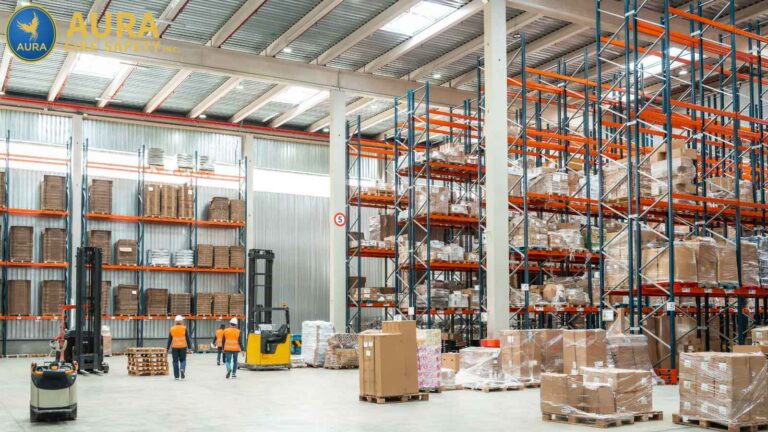
A warehouse fire sprinkler inspection verifies that the system still matches the storage configuration, commodity classification, and clearance requirements the system was designed to handle. NFPA 25 governs the ongoing inspection cadence (quarterly visual, annual functional, 5-year internal and full-flow), while NFPA 13 sets the original design standards the inspection verifies the warehouse still meets, including sprinkler density, head type, and the minimum clearance between storage and the sprinkler deflector. For warehouses and distribution centers in California, the fire sprinkler inspection checks both the system itself and the operational conditions that determine whether it will perform as designed.
Get in Touch for Fire Protection Services
Why Do Warehouses Have Different Sprinkler Inspection Needs?
Warehouses store concentrated combustible loads in configurations that release fire energy faster than typical commercial occupancies. The sprinkler system has to be matched to the specific commodities and storage arrangement on site, and the inspection verifies that the match still holds.
Three factors set warehouse inspections apart:
- High-piled storage thresholds. California Fire Code Chapter 32 applies once the top of storage exceeds 12 feet for Class I–IV commodities, or 6 feet for high-hazard commodities (Group A plastics, rubber tires, idle pallets, flammable liquids). Crossing those thresholds triggers stricter requirements and often a high-piled storage permit.
- Commodity classification under NFPA 13. Stored goods are classified as Class I, II, III, IV, or Group A/B/C plastics. The classification drives required sprinkler density, head type (standard spray, CMSA, ESFR), and whether in-rack sprinklers are needed.
- Storage configuration. Rack storage, palletized, solid pile, and shelf storage each carry different design considerations. A system designed for palletized Class III storage may not work for double-row racks of Group A plastics at the same height.
Clearance between the top of storage and the sprinkler deflector is also critical to spray pattern effectiveness. NFPA 13 sets a minimum 18-inch clearance for standard spray sprinklers and 36 inches for ESFR sprinklers.
What Gets Inspected in a Warehouse Fire Sprinkler System?
A warehouse inspection covers all the standard NFPA 25 components plus warehouse-specific items including in-rack heads, deflector clearance, flue space integrity, and FDC accessibility at loading docks.
Standard NFPA 25 components include control valves, gauges, alarm devices, sprinkler heads, the riser, the fire department connection (FDC), the main drain test on the annual cycle, and the full-flow test on the 5-year cycle.
Warehouse-specific focus areas:
- In-rack sprinklers (where present), including heads, water shields, and supply piping
- Clearance above stored goods to ceiling sprinkler deflectors (18 inches minimum for standard spray, 36 inches for ESFR)
- Flue space maintenance between rack rows, both transverse (front-to-back) and longitudinal (side-to-side)
- Sprinkler head type matched to the current commodity classification on site
- Hose station and FDC accessibility in loading dock and shipping areas where vehicles and pallet activity create obstruction risk
- Dry-pipe system air pressure and compressor function in unheated warehouse sections
- Antifreeze concentration in cold storage loops or low-temperature zones
| Inspection Cycle | What It Covers |
| Quarterly | Visual inspection of valves, gauges, alarm devices, FDC accessibility, head condition |
| Annually | Full functional test of alarm devices, main drain test, dry-pipe trip test, antifreeze concentration check |
| Every 5 years | Internal pipe inspection, full-flow test, sprinkler head sample testing where age requires |
For more on commercial code requirements that apply across building types, see the post on fire sprinkler system code requirements for commercial buildings.
How Do Storage Changes Trigger Compliance Issues?
A sprinkler system designed for one commodity class and storage configuration can become non-compliant when the warehouse changes what it stores or how it stacks it, even if the system itself was never modified. Common change scenarios:
- Switching stored commodities from Class III to Group A plastics
- Adding rack levels that reduce clearance between the top of storage and ceiling sprinklers
- Blocking transverse or longitudinal flue spaces with oversized pallets or shrink-wrapped loads
- Converting an office area to storage, or vice versa, without revisiting sprinkler design
- Increasing storage height above the 12-foot Chapter 32 threshold
- Adding shelving or mezzanines that change the storage profile under existing heads
These changes do not just create deficiencies. They can render the existing system inadequate to control a fire in the new configuration. The system was hydraulically designed for a specific density-area combination; a higher-hazard commodity demands more water, denser sprinkler coverage, or both.
Get in Touch for Fire Protection Services
AHJs often require an updated high-piled storage plan and may trigger a sprinkler system evaluation when commodity or configuration changes are reported. For warehouses approaching a major change, a pre-change review of the existing system against the new storage profile is far less expensive than discovering the mismatch during a fire safety inspection of a large-scale warehouse. The same dynamic plays out in large-format retail, where tenant fit-outs and seasonal merchandise shifts create the same compliance gaps covered in the fire sprinkler inspection checklist for shopping malls.
What Are Common Deficiencies in Warehouse Sprinkler Inspections?
The most common deficiencies in warehouse inspections come from daily operations rather than system aging. Forklift damage, inventory creep, and blocked access points lead the list:
- Sprinkler heads obstructed by high-stacked inventory
- Damaged heads or pipes from forklift impact
- Blocked or obstructed FDCs at loading docks
- Missing or damaged in-rack sprinkler heads
- Inadequate clearance above the top of storage (the 18-inch rule violation is the single most common warehouse finding)
- Painted-over heads from facility refresh projects
- Dry-pipe system air pressure loss in unheated sections
- Frozen pipes in cold storage areas with inadequate antifreeze concentration
- Blocked main drain access
- Loaded sprinkler heads (dust, lint, or product residue affecting activation)
Most of these are correctable through housekeeping changes plus targeted fire sprinkler repairs on damaged components. The pattern most warehouses see is that the same five or six deficiencies show up year after year unless operations introduce a clearance audit and forklift damage protocol.
Working through a deficiency list from a recent inspection, or planning a baseline inspection on a warehouse you just acquired? Aura Fire Safety handles inspections, repairs, and AHJ filings for warehouse and storage facility clients across the San Francisco Bay Area. Schedule a warehouse inspection.
Frequently Asked Questions
How often do warehouse sprinkler systems need inspection?
Quarterly visual inspections, annual full functional testing, and a 5-year internal pipe inspection plus full-flow test under NFPA 25 and California Title 19. Dry-pipe systems and antifreeze loops have additional testing requirements specific to those system types, and high-piled storage areas may carry permit-driven inspection conditions from the local AHJ.
Does adding racking require a sprinkler system modification?
Often yes. Adding rack levels can reduce clearance to ceiling sprinklers below code minimums and may require in-rack sprinklers, denser ceiling protection, or both. The change should be reviewed against the original NFPA 13 design before installation, and the AHJ may require an updated high-piled storage plan.
What is the required clearance between storage and sprinkler heads?
NFPA 13 requires a minimum 18-inch clearance between the top of storage and the deflector for standard spray sprinklers. ESFR sprinklers require a minimum 36-inch clearance unless specifically listed otherwise. Rubber tire storage also requires 36 inches. The 18-inch rule is the most commonly violated requirement in occupied warehouses.
Are cold storage warehouses inspected differently?
Yes. Cold storage warehouses typically use dry-pipe or antifreeze systems that require additional testing of air compressors, low-point drains, and antifreeze concentration. Inspection scheduling also has to account for operational temperatures and the time required to drain and refill specific zones.
Who is responsible for maintaining flue spaces?
Flue space maintenance is a daily operational responsibility of the warehouse operator or tenant, but the building owner remains responsible for code compliance with the AHJ. Lease terms typically allocate operational maintenance to the tenant while compliance liability stays with the owner.
Get in Touch for Fire Protection Services