
Fire sprinkler inspection violations in California trigger escalating enforcement from the local fire department, starting with a Notice of Violation and progressing through administrative citations, daily fines, re-inspection fees, and in serious cases, building closure. Required by California Title 19 and NFPA 25, fire sprinkler inspections verify that water-based fire protection systems will perform during a fire, and missed or failed inspections create a paper trail that follows the property, the owner, and the insurance policy.
What Happens If You Miss a Required Fire Sprinkler Inspection?
The local Authority Having Jurisdiction (AHJ) issues a Notice of Violation (NOV) once a missed or failed inspection is identified, typically within 15 days of the finding. Under the San Francisco Fire Code, the NOV identifies the code sections violated, describes the deficiency, and sets a correction deadline.
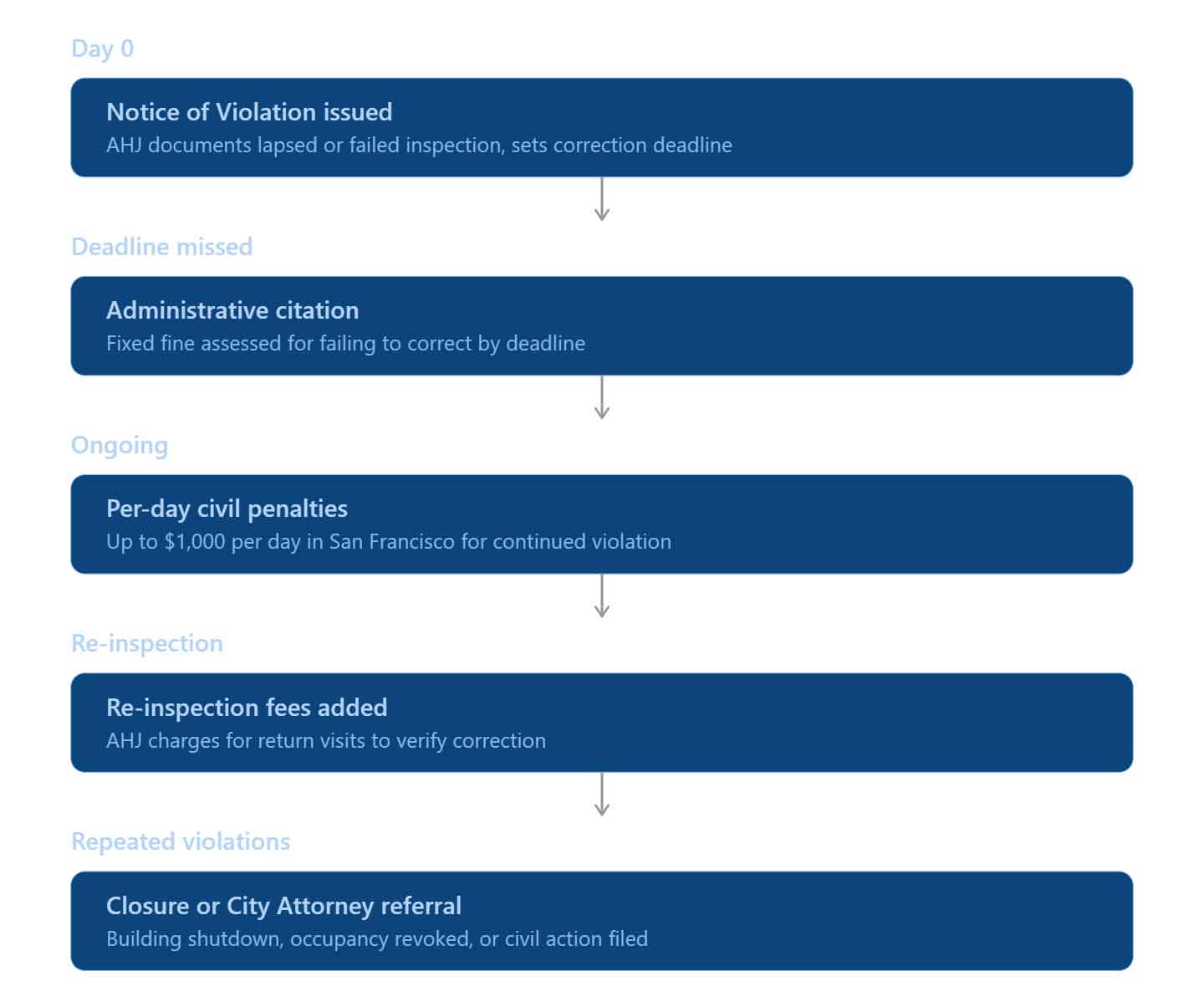
Enforcement does not stop at the initial notice. Each missed deadline moves the violation to the next stage, with penalties compounding at every step. The timeline below shows how a single missed inspection can escalate from a paper notice to building closure when corrections are not made on time.
AHJs identify lapsed compliance through several channels. Title 19 confidence test reports filed by licensed contractors are tracked against expected dates. Routine fire prevention bureau audits flag buildings without current reports. Tenant complaints often trigger inspections directly. Once a violation is documented, the fire code official has authority to require immediate compliance for any condition that creates an imminent life-safety hazard.
What Are the Fines for Fire Sprinkler Non-Compliance in California?
Fines vary by jurisdiction, but most Bay Area AHJs follow a tiered structure that begins with a fixed administrative citation and adds per-day civil penalties for continued violations. In San Francisco, certain code violations carry a $1,000 administrative citation, and civil penalties can reach up to $1,000 per day for each day the violation continues, in addition to attorney’s fees and costs recoverable through civil action.
Under California Government Code Section 36900, infractions of local building and safety codes carry tiered penalties: up to $130 for a first violation, up to $700 for a second violation of the same ordinance within one year, and up to $1,300 for each additional violation of the same ordinance within one year. Misdemeanor charges are available for serious or repeated non-compliance.
Common cost categories owners encounter:
| Cost Category | What Triggers It |
| Administrative citation | Failure to correct an NOV by the deadline |
| Per-day civil penalty | Ongoing, uncorrected violation |
| Re-inspection fee | AHJ return visit to verify correction |
| Administrative hearing referral fee | Contested citation requiring a hearing |
| Late filing fee | Title 19 confidence test report submitted past due |
| Misdemeanor fine | Willful or repeated non-compliance |
Exact amounts change. Owners should verify current fee schedules with their local fire prevention bureau before estimating exposure.
How Do Fire Sprinkler Violations Affect Insurance Coverage?
Insurers commonly treat current inspection records as a baseline condition of coverage for commercial and multi-unit residential properties. A documented violation can affect three things: claim outcomes after a fire loss, premium pricing at renewal, and whether the policy is renewed at all.
If a fire occurs while a sprinkler system is out of compliance, the carrier may investigate whether the lapsed inspection contributed to the loss or violated policy conditions. Documented Title 19 reports serve as proof of due diligence by showing the system was inspected, tested, and maintained on the schedule the policy expects.
Premium increases after a violation history are common, and repeated non-compliance can lead to non-renewal. Property owners with lender-financed buildings face an additional layer: lenders often require proof of current fire protection inspections as a loan covenant, and lapses can trigger loan default reviews. Specific coverage questions belong with the insurance carrier or broker, but the underlying record, clean or not, is built by the inspection paperwork on file with the AHJ.
What Is the Liability Exposure for Building Owners?
Building owners face civil liability when an uninspected or non-compliant fire sprinkler system fails to perform during a fire. Plaintiffs in property damage and personal injury cases routinely point to inspection records, or the absence of them, as evidence of negligence.
Three exposure categories matter most:
- Property damage to the owner’s building and adjacent properties when a non-functioning system fails to control a fire
- Tenant injury and wrongful death claims in multi-unit residential buildings, where the duty of care is highest
- Negligence and breach of duty arguments built on documented inspection lapses, expired tags, or uncorrected NOVs
A current, complete inspection record is one of the strongest defenses available. It demonstrates the owner met the standard of care required by California Title 19 and NFPA 25. For more on staying ahead of these issues, see how Aura Fire Safety helps clients avoid costly fire code violations.
How to Get Back Into Compliance After a Violation
Returning to compliance follows a defined sequence. Acting quickly limits per-day penalties and closes the violation before it escalates to a hearing or referral.
- Schedule a full inspection with a licensed C-16 fire protection contractor. Request the inspection type that matches the lapsed requirement — quarterly, annual, or 5-year.
- Correct every deficiency listed in the NOV. Common items include replacing corroded or painted sprinkler heads, restoring valve positions, repairing alarm devices, and clearing obstructions. Fire sprinkler repairs should match the exact code sections cited in the NOV.
- File the corrected Title 19 confidence test report with the AHJ. The report should reference the NOV number and document each correction.
- Request re-inspection or written closure of the violation. Some AHJs accept the filed report as closure; others require a return visit. Re-inspection fees apply.
- Establish a recurring inspection schedule — quarterly visual inspections, annual testing, and 5-year internal pipe and full-flow testing — so the next compliance cycle is documented before the AHJ asks. For an ongoing approach, see the guide on staying compliant with fire inspection requirements.
Working through an open NOV on a tight correction deadline? Aura Fire Safety handles inspections, repairs, and AHJ filings across the San Francisco Bay Area. Get in touch to schedule a compliance inspection.
Frequently Asked Questions
Can a building be shut down for fire sprinkler violations?
Yes. Fire code officials in California have authority to order building closure, revoke the certificate of occupancy, or issue a Fire Life Safety Notice and Order when violations create an imminent life-safety hazard or remain uncorrected after multiple notices. In residential buildings with three or more units, this includes situations where a non-working sprinkler system substantially endangers residents.
How quickly must violations be corrected?
Correction timelines are set by the AHJ in the Notice of Violation. Routine deficiencies often carry a 30-day correction window, while imminent hazards require immediate action. The deadline appears on the NOV itself, and missing it converts the notice into an administrative citation with daily penalties.
Do fire sprinkler violations appear on public record?
Yes. Notices of Violation, administrative citations, and Fire Life Safety Notices recorded by the fire code official are typically public records. They can also be recorded in the Assessor-Recorder’s Office for serious cases, which means the violation appears in title searches and property disclosures during real estate transactions.
Can tenants report fire sprinkler violations?
Yes. Tenants can file complaints directly with the local fire department or fire prevention bureau. Complaint-driven inspections are a primary enforcement channel in multi-unit buildings, and the AHJ is required to investigate credible reports.
Does a violation from a previous owner affect the current owner?
Yes. Open code violations transfer with the property. The new owner inherits responsibility for correction, and any accrued daily penalties or unpaid fines remain attached to the parcel. Buyers should review the AHJ’s records and request property disclosures before closing.